
The Conscious Divorce Prep List
Do this before you file for divorce
Late at night, your phone buzzes with a text from your ex that instantly triggers tension. The message mixes logistics with criticism, and suddenly your nervous system is in overdrive. Your chest tightens, your jaw clenches, and sleep becomes impossible. Sound familiar?
If you are navigating co-parenting after divorce, these moments are exhausting. They disrupt your peace, affect your sleep, drain your energy, and can leave you emotionally hungover the next day while trying to be present for your children. The good news is that there is a better way. Strong, clear boundaries are not about conflict or punishment. They are about reclaiming your power, protecting your energy, modeling healthy behavior, and creating stability for your children.
In a recent episode of The Conscious Divorce podcast, I broke down exactly how to build and hold effective boundaries. Here is an expanded practical summary drawn from that conversation to help you move forward with clarity and confidence.
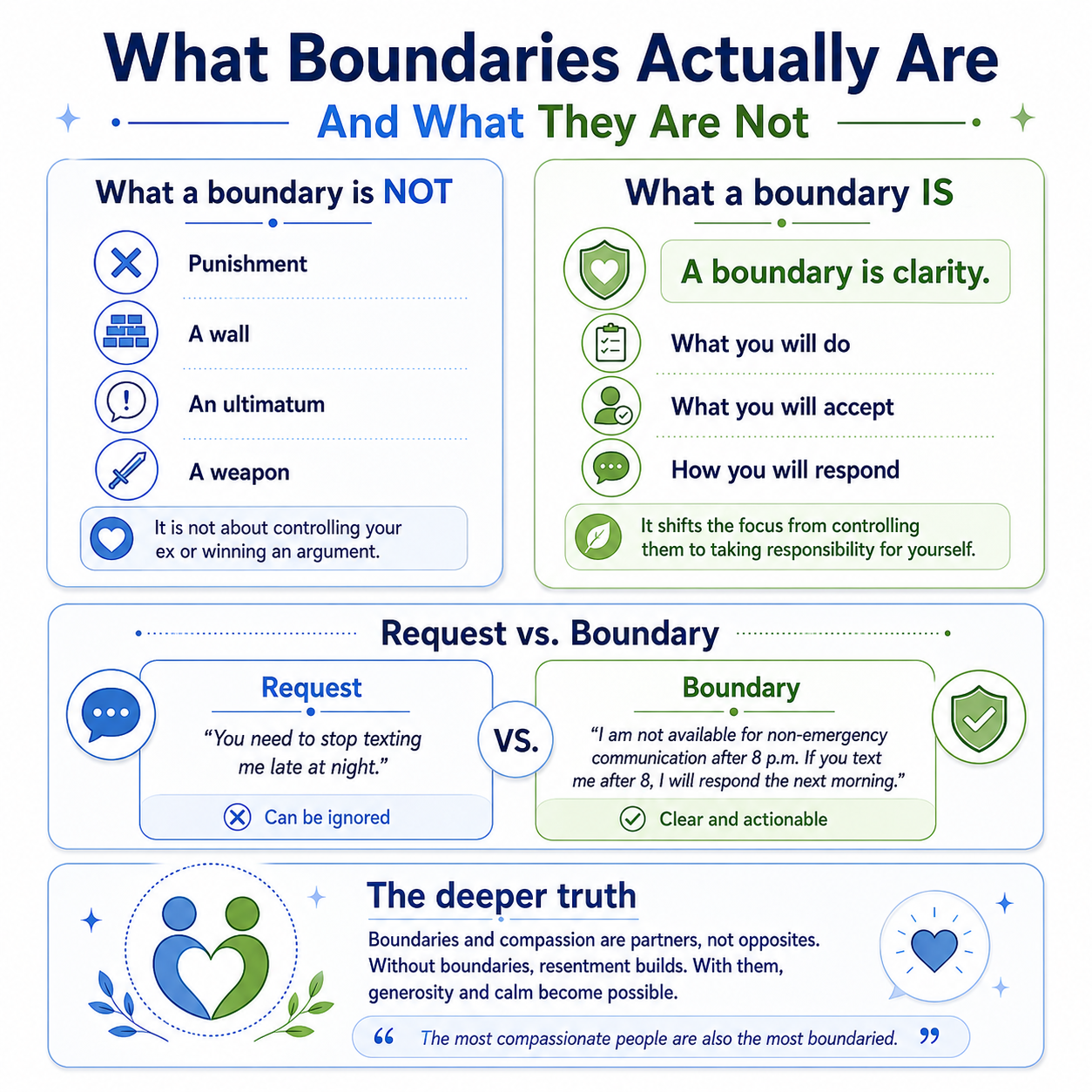
What Boundaries Actually Are (and What They Are Not)
A boundary is not a punishment, a wall, an ultimatum, or a weapon. It is not about controlling your ex’s behavior or winning an argument.
A boundary is clarity. It is a clear statement about what you will do, what you will accept, and how you will respond.
Most people set boundaries backwards. They say, “You need to stop texting me late at night.” That is a request that can be ignored. A true boundary sounds like this: “I am not available for non-emergency communication after 8 p.m. If you text me after 8, I will respond the next morning.”
This shift from trying to control the other person to taking responsibility for your own actions changes everything. As Brené Brown has noted, the most compassionate people she has interviewed are also the most boundaried. Boundaries and compassion are partners, not opposites. Without boundaries, resentment builds. With them, sustained generosity and calm become possible.
Why Boundaries Feel So Difficult: The Neuroscience
Your ex knows your triggers intimately. When a provocative message arrives, your amygdala fires before your prefrontal cortex can engage. Dr. John Gottman describes this as emotional flooding. Once your heart rate exceeds roughly 100 beats per minute, rational thought, empathy, and problem-solving drop dramatically. You are no longer thinking. You are surviving.
Attachment styles, old trauma patterns, and even trauma bonding can make boundaries feel unsafe or “mean.” The discomfort you feel when setting them is often withdrawal from chaotic patterns, not evidence that you are doing something wrong. Widening the space between stimulus and response (as Victor Frankl taught) is the real work. It turns reaction into thoughtful response.
Clear boundaries benefit everyone by reducing ambiguity and anxiety. Predictable rules allow nervous systems, including your children’s, to stand down.
Boundaries Across the Co-Parenting Spectrum
Tailor your approach to your specific dynamic:
Cooperative Co-Parenting: Protect what works. Proactively define scheduling changes, privacy, introductions of new partners, holidays, finances, and communication expectations. Cooperate fully on parenting while keeping personal lives separate.
Cordial but Strained: Add structure. Use parenting apps for documentation, establish reasonable response windows (for example, 24 hours for non-urgent matters), reduce emotional language, and create predictable routines. Business-like communication becomes the standard.
High Conflict: Move toward parallel parenting. Minimize joint decision-making where possible and communicate only about logistics in writing. The BIFF method (developed by Bill Eddy) is essential here: Brief (2 to 4 sentences), Informative (facts only), Friendly (civil tone), and Firm (state your position clearly without negotiation or defense).
Complement this with the Grey Rock method: become emotionally uninteresting and refuse to engage with provocations, insults, or attempts to refight the marriage. Do not defend every accusation. Document everything calmly for your records.
When Boundaries Are Ignored: Enforcement turns a boundary into reality. A boundary without enforcement is merely a wish. Respond consistently (for example, delay replies to late texts until morning), use pre-written scripts, start small if needed, and escalate to mediators or attorneys when patterns persist. Build emotional tolerance one held boundary at a time.
Unsafe or Abusive Dynamics: Safety comes first. This may require restraining orders, supervised exchanges, custody modifications, or professional intervention. Listen to your instincts and contact resources like the National Domestic Violence Hotline (1-800-799-7233).
Practical Scripts You Can Use Tonight
- Late-night or non-urgent texts: “I am not available for non-emergency communication after 8 p.m. I will respond tomorrow morning.”
- Conversations drifting to the past: “I am available to discuss parenting logistics. I am not available to revisit the marriage.”
- Personal attacks: “I will not continue this conversation if I am being insulted. I am happy to discuss the issue when the conversation is respectful.”
- Involving the children: “This is an adult issue. Please do not involve the children.”
- Scheduling or disagreements: “I will follow the parenting plan as written. If you would like a modification, please contact our mediator or attorney.”
Keep all responses short, factual, and focused on your own behavior.
Why This Matters Most: Protecting Your Children
Research is unambiguous. The single greatest predictor of children’s post-divorce adjustment is the level of conflict they are exposed to between their parents, not whether the parents stayed together. Dr. Robert Emery’s extensive work highlights that children thrive when shielded from ongoing parental conflict.

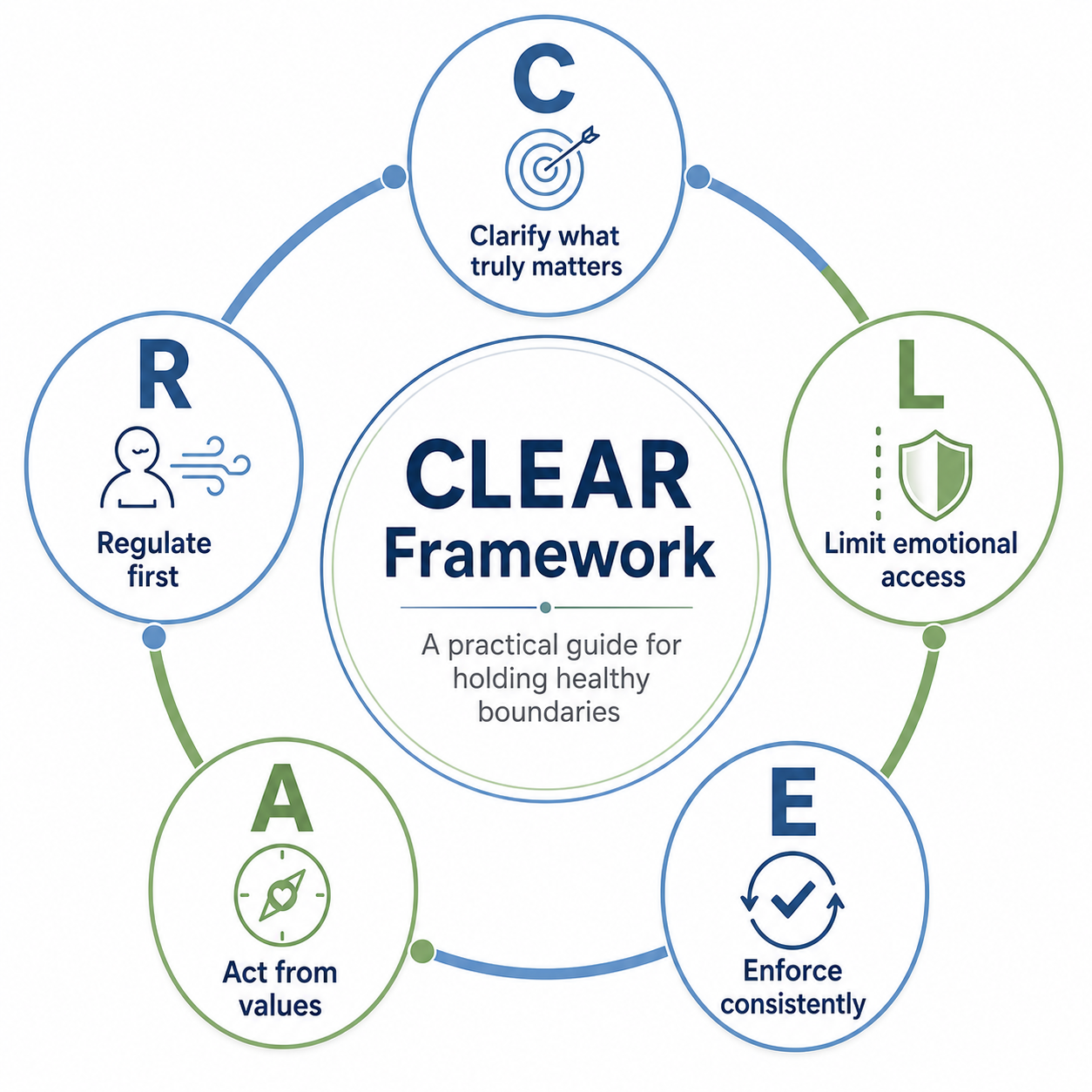
The CLEAR Framework
Return to this when you feel triggered, pressured, or tempted to react.
- C: Clarify what truly matters
Pause and ask: Is this about the kids and logistics, or am I being pulled into ego, fear, or old pain? Keep your focus on what actually needs attention. - L: Limit emotional access
You do not have to respond to every criticism, defend every accusation, or let someone disrupt your peace. Keep communication short, factual, and focused. - E: Enforce consistently
A boundary only works when you follow through. If you say you will not respond after 8 p.m., wait until morning. Calm consistency builds trust with yourself. - A: Act from values, not triggers
Let your response reflect the parent and person you want to be. Choose dignity, peace, and stability over reaction. - R: Regulate first
Before responding, breathe, walk, pause, or wait. A calm nervous system helps you communicate clearly instead of reacting emotionally.
Final Truths for the Journey
Your ex may never validate your efforts or respect your boundaries. Peace may require being misunderstood at times. Stop waiting for their emotional maturity. The goal is not to win a war but to remove your children from the battlefield.
Every boundary you hold is a vote for the calm, self-respecting parent you are becoming. It is an act of faith in your worth and in the stronger, clearer life ahead.
I have seen remarkable transformations: people who once shook while texting now respond with calm authority. You can too.
What is one boundary you can strengthen this week? Share in the comments. Your experience may help another parent feel less alone.
You have the power to write your next chapter with intention. Start today with the next boundary you set and hold.
If you are preparing for divorce, this book is for you.
You 2.0: Divorce, A Better Way Forward goes surface level advice. It gives you the framework, the neuroscience, and the practical tools to build something most people don’t believe is possible: rebuilding your life and identity after divorce.
Get your copy of You 2.0 and start building what comes next.
Ready to Dive Deeper Into Your Conscious Divorce Transformation?
Explore the complete frameworks and get hands-on tools to accelerate your transformation journey.
Book A Free Strategy Call
30 minute call. No pressure. Just clarity and a plan.
10-minute Divorce Readiness Quiz
Not ready to talk yet? Start here