
The Conscious Divorce Prep List
Do this before you file for divorce
Divorce is not just an emotional ending. It is one of the most significant financial and legal transitions most people will ever face. Yet far too many enter the process unprepared, believing that staying kind or keeping things civil means they do not need a clear strategy.
On a recent episode of The Conscious Divorce Podcast, I shared the story of Carol, a 53-year-old woman married for 26 years. She had suspected trouble for two years and spent that time in therapy, trying to be the bigger person and avoiding conflict. One Thursday afternoon, she was served divorce papers in her own kitchen. Her husband had quietly prepared for eight months: meeting with a lawyer, moving money, changing beneficiaries on life insurance policies, and renting an apartment. Carol had been planning their anniversary dinner.
What devastated her most was not the divorce itself, but the preparation gap. She told me, “I thought being a good person meant I did not need to pay attention. I thought love was enough. I had no idea what I owned, what was mine, or what was gone.”
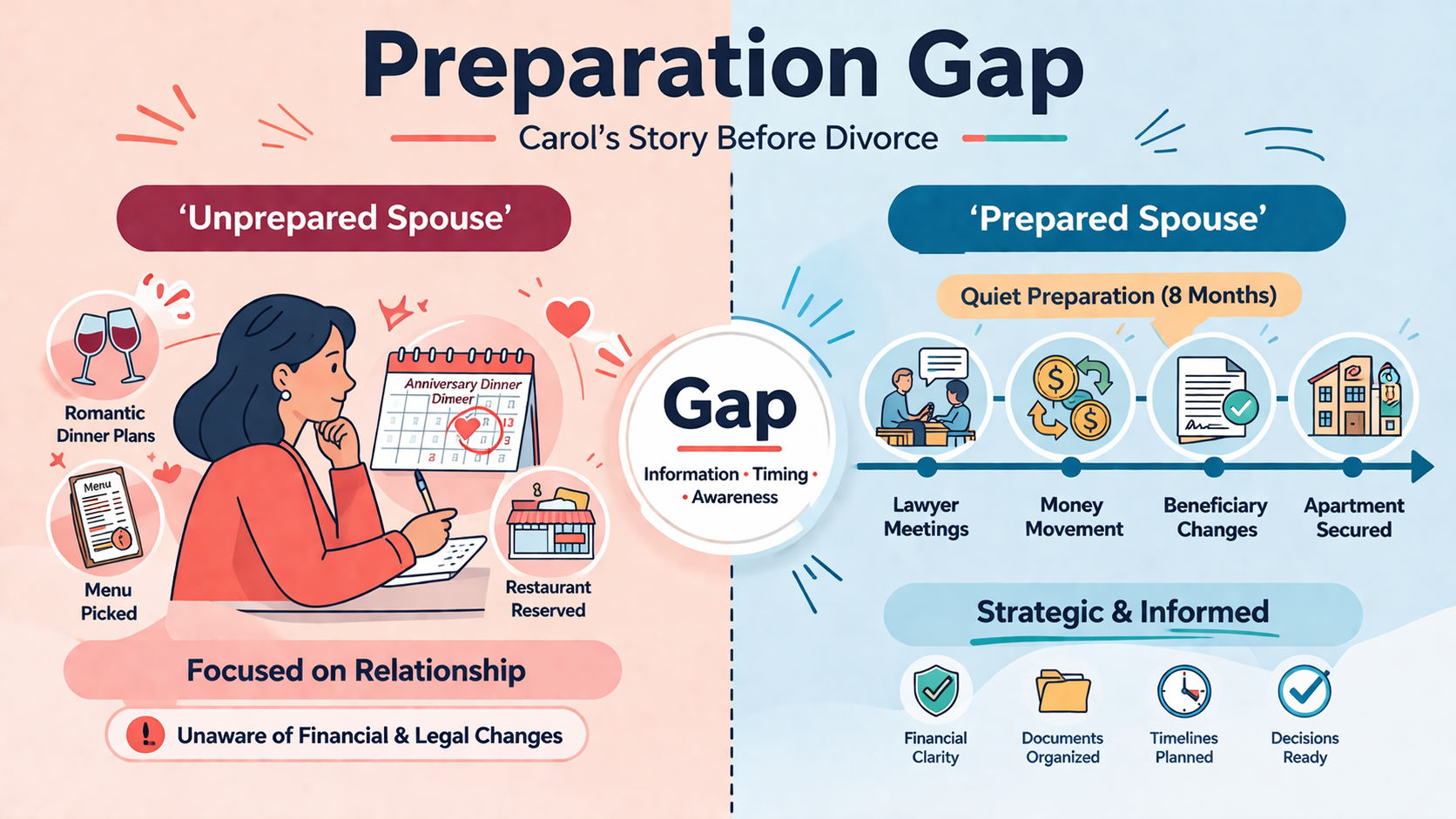
That is why the episode is called “Before You File: The Conscious Divorce Prep Checklist No One Talks About.” This is not about becoming adversarial or cold. It is about showing up with clarity and dignity while still honoring your values.
The Biggest Invisible Trap
The most damaging trap in divorce is the belief that being a decent person means you do not need to think strategically. Wanting a respectful, low-conflict process is admirable, but those values are not a substitute for preparation.
You can remain kind and still know your accounts, monthly spending, credit score, and retirement balances. Research consistently shows that people who enter divorce informed and organized make fewer costly mistakes, avoid panic-driven settlements, and are less likely to leave assets behind.
Financial disorganization during divorce is one of the top predictors of long-term economic distress, especially for the partner who was less involved in household finances during the marriage. Studies, including those from Fidelity Investments, reveal that 54 percent of people acknowledge making financial mistakes during divorce, with regret nearly doubling for those who were disengaged from finances beforehand. Those who stayed involved recover faster and report better financial outcomes.
Preparation is not aggression. It is clarity and self-preservation. It reduces the decision-making load when emotions run high and stress hormones impair clear thinking.
What the Research Shows
Study after study confirms that early engagement with legal and financial professionals leads to higher satisfaction with outcomes, even when the results are difficult. The American Psychological Association notes that it is not the divorce itself that harms children most, but ongoing high levels of inter-parental conflict. Children exposed to persistent conflict, whether parents stay together or divorce, often face worse developmental outcomes. Low-conflict divorces with strong co-parenting protect kids far better.
Financial data is equally sobering. Women, on average, experience a steeper post-divorce drop in household income (often 41 percent in the first year) compared to men (around 21 percent). This pattern holds across many studies, though it is shifting with newer generations. Divorced women also tend to have roughly 50 percent less in retirement savings than married women. Men recover faster on average, but both genders see significant wealth declines. Informed preparation helps close this gap and protects everyone involved.
Out-of-court options like mediation and collaborative divorce consistently deliver lower costs, shorter timelines, lower conflict, and higher compliance with agreements. However, these processes work best when both parties arrive informed. Information asymmetry can turn respectful resolution into a leverage problem.
Stories from Real Experiences
Ari, 47 and married 18 years, believed their finances were straightforward until mediation revealed undisclosed transfers totaling over 40,000 dollars from a joint account, a hidden home equity line of credit, and higher credit card balances than he realized. His wife had been organized; he was scrambling in real time. The asymmetry cost him money, time, confidence, and a sense of control.
In contrast, Diana, 41 and married 12 years with two children, sensed trouble 18 months ahead. She quietly opened a separate email and bank account, downloaded statements, tracked spending, listed retirement accounts, and consulted an attorney. When her husband announced the divorce, she was heartbroken but not blindsided. Her mediation process took about seven months and felt navigable rather than chaotic. Preparation did not eliminate the pain, but it gave her steadiness.
The Practical Conscious Divorce Prep Checklist
Here is the expanded checklist drawn from the episode and standard financial planning guidance. Do not attempt everything at once. Start with the most urgent items for your situation.
Financial Records
Gather the last three to five years of joint and individual tax returns (download from IRS.gov if needed). Include W-2s, 1099s, and any Schedule K-1s. These documents serve as a complete financial X-ray. Collect two or more years of bank, credit card, investment, and retirement account statements. List every 401(k), IRA, pension, and deferred compensation plan for both spouses. Understand vesting and growth during the marriage, as most states treat marital portions as shared assets.
Property, Assets, and Debts
Obtain deeds, current mortgage statements, vehicle titles, and loan balances for all real estate and vehicles. Pull credit reports for both parties (free at annualcreditreport.com) to identify every account and balance. Document business interests, stock options, RSUs, or LLC stakes, which often require professional valuation. List all debts, including student loans, medical bills, personal loans, HELOCs, and tax liabilities. Joint debts do not automatically disappear; they must be addressed explicitly.
Insurance and Estate Documents
Review life insurance policies and current beneficiaries. Check health, disability, long-term care, homeowners, and renters insurance details, including COBRA options post-separation. Locate existing wills, trusts, powers of attorney, and healthcare proxies. These will need updating after divorce.
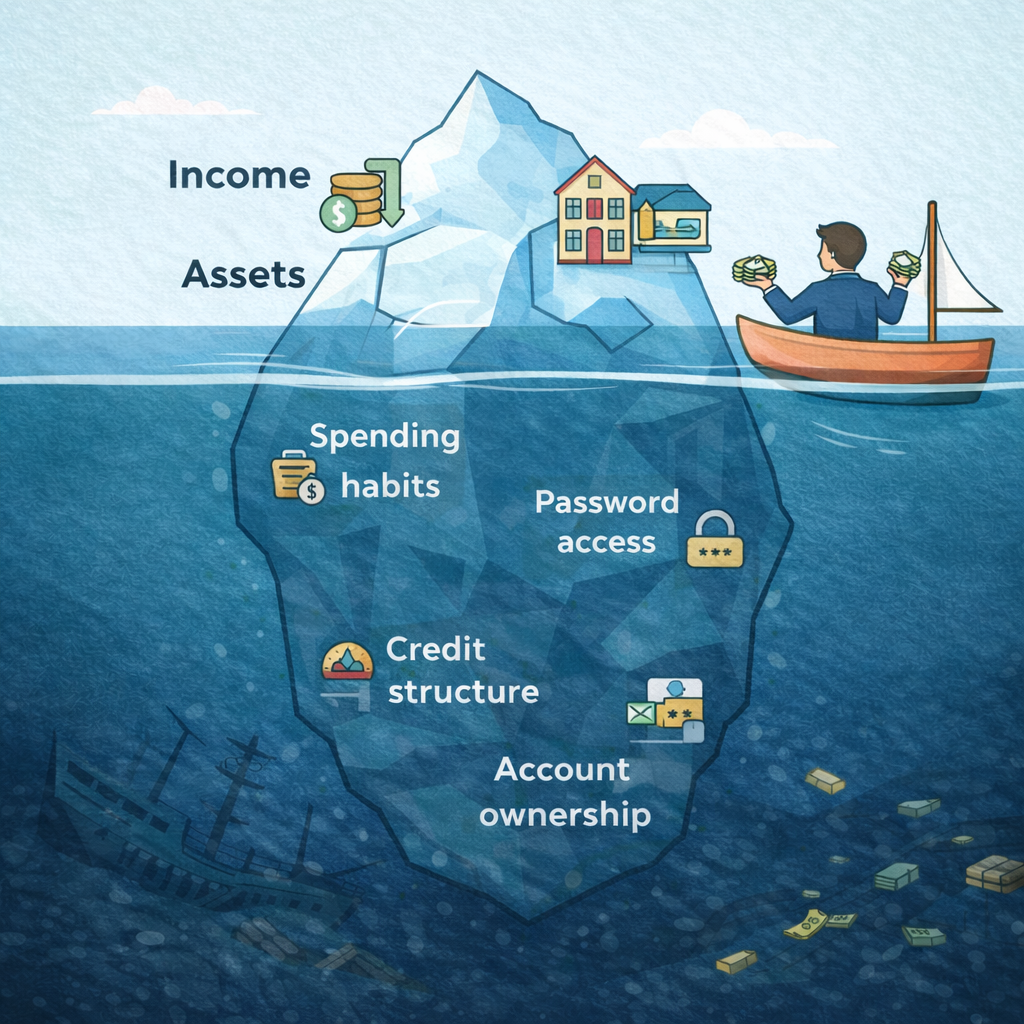
The Shadow Picture (Often Overlooked but Critical)
Track your actual monthly household spending for at least 30 days using statements or a simple spreadsheet. Do not estimate. Understand all sources of income, including side gigs or business revenue. Secure passwords and access to all important accounts before they become restricted. Know your credit score and history, distinguishing between accounts where you are the primary holder versus an authorized user.
Additional practical items from financial checklists include recent pay stubs, utility bills, safe deposit box contents, and any loan applications or financial statements from the past year. Document personal property such as jewelry, artwork, or collectibles with photos or inventories.
Emotional and Mindset Traps That Cost the Most
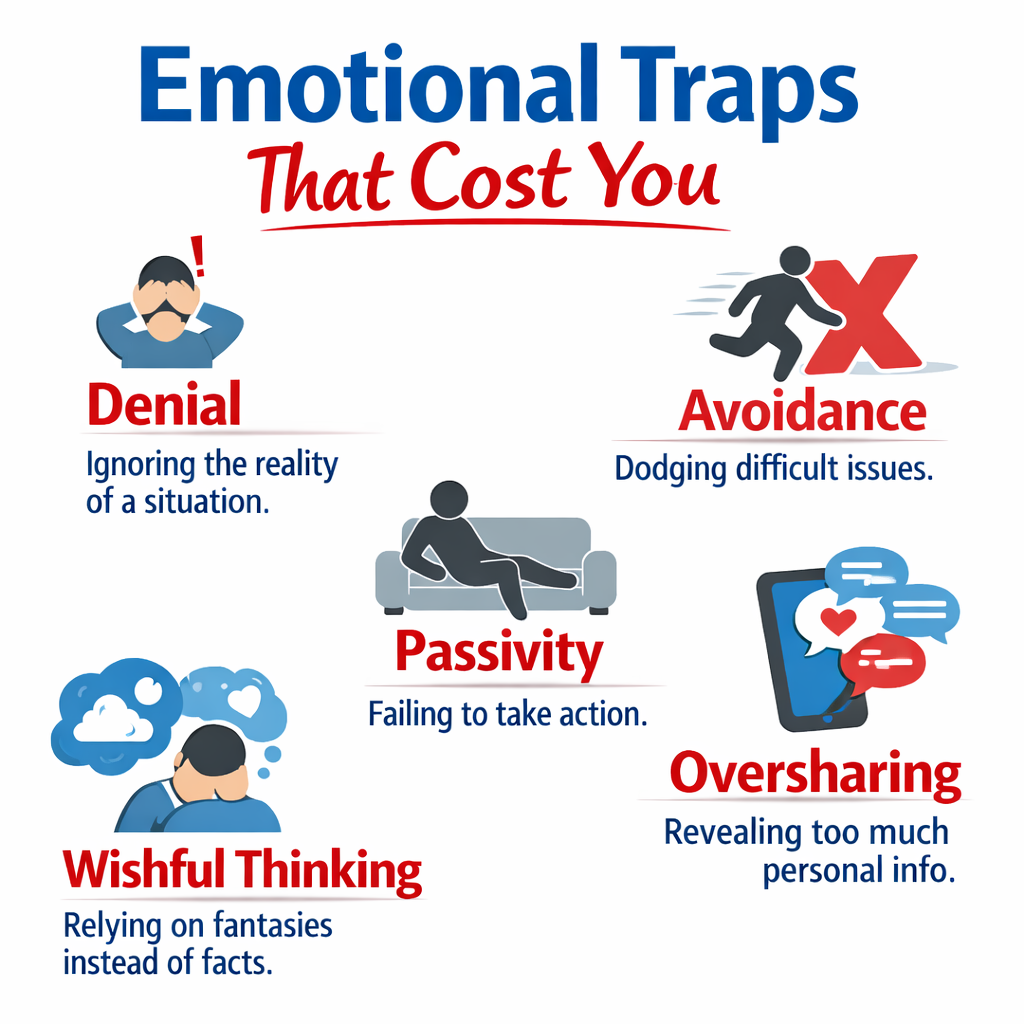
Documents alone are not enough. Common emotional mistakes include denial (“It probably will not get that bad”), wishful thinking about voluntary full disclosure, avoiding the numbers entirely, confusing kindness with passivity, oversharing plans too early, and believing your lawyer will handle everything.
Denial is especially costly because every week one spouse prepares while the other remains unaware widens the gap. Avoidance of numbers often stems from fear, yet the reality is almost always less distressing than the imagination, and the cost of ignorance shows up in settlements and legal fees.
Build the right team intentionally: a family law attorney for legal matters, a Certified Divorce Financial Analyst (CDFA) for the numbers, a therapist for emotional processing, and a divorce coach as your strategic thought partner. A divorce coach helps you organize priorities, regulate emotions during negotiations, use attorney time efficiently, and turn reactive moments into grounded decisions. Many who work with coaches report saving time and money while feeling more confident and less overwhelmed.
Mindset Reset: What This Is Really About
Preparation does not mean treating your marriage like a transaction or becoming cold and calculating. It means respecting yourself enough to understand your own situation and reducing chaos so you can show up as a better participant in this major life transition.
People who prepare early tend to be less angry and reactive. They become stronger co-parents because they are not constantly in survival mode. Stability from preparation protects your children, your reputation, your relationships, and your future.
This is not about winning at all costs. It is about not losing yourself or your long-term wellbeing in the process.
What You Can Actually Do This Week
Pick two or three actions based on your circumstances:
- Find a divorce coach or therapist experienced in life transitions.
- Pull the last three years of tax returns from the IRS website and save them privately.
- Download two years of bank and credit card statements to a secure, private folder.
- Pull your free credit report and review all accounts.
- Open a separate private email account for financial and legal correspondence.
- Create a simple one-page inventory of accounts and assets.
- Track your actual monthly expenses for 30 days.
- Schedule a one-hour consultation with a family law attorney in your state (for understanding only).
- Consider a consultation with a Certified Divorce Financial Analyst.
- If children are involved, begin a factual parenting calendar.
Final Thought
Divorce does not have to be a shipwreck. It can be a difficult but intentional crossing. The people who navigate it best are those who show up prepared, informed, and grounded enough to make decisions they can live with long term.
Carol, Ari, and Diana all eventually found their footing, but those who close the preparation gap earlier experience less regret and more stability.
If you are in the gray zone, seriously considering separation, or simply realizing you need to pay closer attention, I hope this gives you a clearer path forward.
Listen to the full episode of The Conscious Divorce Podcast for the complete discussion. My book You 2.0: Divorce – A Better Way Forward and the companion workbook are available on Amazon.
I offer free 30-minute consultations at reclaimandreboot.me for those ready to move from reacting to strategically rebuilding.
If this resonated, please share it with someone who might need it. Divorce is hard enough. Going through it with eyes open and preparation makes a meaningful difference.
What is one preparation step you have taken or plan to take? I welcome your thoughts in the comments.
If you are preparing for divorce, this book is for you.
You 2.0: Divorce, A Better Way Forward goes surface level advice. It gives you the framework, the neuroscience, and the practical tools to build something most people don’t believe is possible: rebuilding your life and identity after divorce.
Get your copy of You 2.0 and start building what comes next.
Ready to Dive Deeper Into Your Conscious Divorce Transformation?
Explore the complete frameworks and get hands-on tools to accelerate your transformation journey.
Book A Free Strategy Call
30 minute call. No pressure. Just clarity and a plan.
10-minute Divorce Readiness Quiz
Not ready to talk yet? Start here