
First Holidays After Divorce: How to Cope and Rebuild
By: Justin Milrad – CDC Certified Divorce Coach®, Marriage and Relationship Coach, MBA, Financial Planner
Build a Holiday “Not-to-Do” List
Most people plan what they are going to do during the holidays. Justin suggests planning what you will not do when emotions are high. That matters because stress can narrow attention and impair working memory, response inhibition, and flexible decision-making. It is more accurate to say stress can make thoughtful decisions harder than to say the rational brain simply “shuts off.”
A useful not-to-do list might include: I will not send an angry text after drinking. I will not make a major financial or parenting decision in the middle of a holiday argument. I will not use social media to compare my new reality with someone else’s highlight reel. I will not put my children in the middle of an adult dispute.
Research reviews on stress and executive function support this basic strategy: when pressure is high, your capacity for inhibition, attention, and flexible thinking can be compromised. That is a good reason to create your rules before you are triggered.
Co-Parent the Holiday From the Big Picture
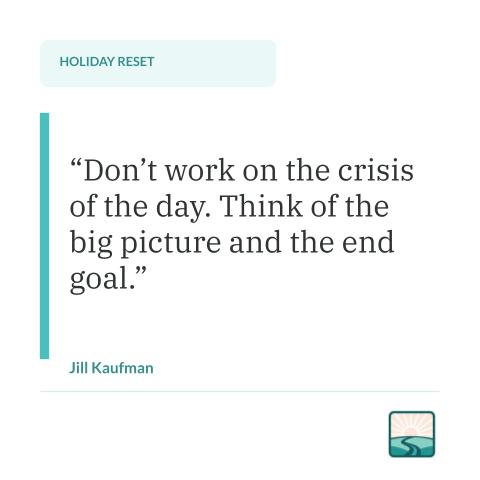
Jill’s strongest co-parenting advice is perspective. Do not turn the crisis of the day into the entire divorce. Ask what you want the long-term parenting relationship to look like and what your children need to remember about how you handled this season.
That does not mean celebrating together. A joint holiday only works if both parents can reliably stay calm, respectful, and child-focused. If one comment could ignite a scene in front of the children, separate celebrations may be healthier.
Holiday dates are also more flexible than they can feel. Christmas Eve, Christmas morning, a later family dinner, or a Hanukkah celebration on a different night can still carry meaning. The goal is not ownership of a date. It is meaningful time with your children.
Use written communication when the conversation is tense
Jill often recommends email because you can draft, pause, review the tone, and remove the old marital argument from the scheduling issue. For higher-conflict exchanges, the BIFF method is a useful structure: keep the message Brief, Informative, Friendly, and Firm.
| Instead of | Try |
|---|---|
| “You always ruin the holidays. You better not change the pickup time again.” | “I’m planning to pick up the kids at 1:00 p.m. on December 24 as scheduled. Please let me know by Friday if there is a conflict.” |
For a deeper scheduling and communication framework, see Reclaim & Reboot’s existing Holiday Co-Parenting Guide.
You Do Not Have to Compete With the Other Household
A parent with less money may watch the other household book the bigger trip, buy the more expensive gift, or host the more impressive celebration and feel as though they are losing. Jill’s answer is simple: your relationship with your children is not a spending contest.
Connection is built through attention, consistency, conversation, shared rituals, and the feeling of being known. If the other parent can afford more, let that be true without turning your home into a financial arms race. A child can enjoy a vacation with one parent and still treasure hot chocolate, a movie, a hike, a homemade dinner, or a night of music with the other.
The same principle applies when relatives criticize your ex in front of the kids. Redirect the moment and address the adult privately. Children should not have to defend one parent while celebrating with the other family.
Build a Holiday “Not-to-Do” List
Most people plan what they are going to do during the holidays. Justin suggests planning what you will not do when emotions are high. That matters because stress can narrow attention and impair working memory, response inhibition, and flexible decision-making. It is more accurate to say stress can make thoughtful decisions harder than to say the rational brain simply “shuts off.”
A useful not-to-do list might include: I will not send an angry text after drinking. I will not make a major financial or parenting decision in the middle of a holiday argument. I will not use social media to compare my new reality with someone else’s highlight reel. I will not put my children in the middle of an adult dispute.
Research reviews on stress and executive function support this basic strategy: when pressure is high, your capacity for inhibition, attention, and flexible thinking can be compromised. That is a good reason to create your rules before you are triggered.
Co-Parent the Holiday From the Big Picture
Jill’s strongest co-parenting advice is perspective. Do not turn the crisis of the day into the entire divorce. Ask what you want the long-term parenting relationship to look like and what your children need to remember about how you handled this season.
That does not mean celebrating together. A joint holiday only works if both parents can reliably stay calm, respectful, and child-focused. If one comment could ignite a scene in front of the children, separate celebrations may be healthier.
Holiday dates are also more flexible than they can feel. Christmas Eve, Christmas morning, a later family dinner, or a Hanukkah celebration on a different night can still carry meaning. The goal is not ownership of a date. It is meaningful time with your children.
Use written communication when the conversation is tense
Jill often recommends email because you can draft, pause, review the tone, and remove the old marital argument from the scheduling issue. For higher-conflict exchanges, the BIFF method is a useful structure: keep the message Brief, Informative, Friendly, and Firm.
| Instead of | Try |
|---|---|
| “You always ruin the holidays. You better not change the pickup time again.” | “I’m planning to pick up the kids at 1:00 p.m. on December 24 as scheduled. Please let me know by Friday if there is a conflict.” |
For a deeper scheduling and communication framework, see Reclaim & Reboot’s existing Holiday Co-Parenting Guide.
You Do Not Have to Compete With the Other Household
A parent with less money may watch the other household book the bigger trip, buy the more expensive gift, or host the more impressive celebration and feel as though they are losing. Jill’s answer is simple: your relationship with your children is not a spending contest.
Connection is built through attention, consistency, conversation, shared rituals, and the feeling of being known. If the other parent can afford more, let that be true without turning your home into a financial arms race. A child can enjoy a vacation with one parent and still treasure hot chocolate, a movie, a hike, a homemade dinner, or a night of music with the other.
The same principle applies when relatives criticize your ex in front of the kids. Redirect the moment and address the adult privately. Children should not have to defend one parent while celebrating with the other family.
You 2.0: Divorce; A Better Way Forward
I thought my divorce would destroy me. Instead, it became the catalyst for creating a life more authentic and purposeful than I’d ever imagined possible.
You 2.0 is the blueprint I wish I’d had. Born from my own messy journey and refined through coaching others from survival to transformation. This isn’t about picking up the pieces of your old life. It’s about becoming the architect of something entirely new
When the Kids Are Away, Do the Work That Belongs to You
The hardest hours of the holiday may also be the first uninterrupted hours you have had in months. Jill encourages people to use some of that time for rebuilding rather than only distraction. That does not mean every minute has to become a self-improvement project. Rest is allowed. Netflix is allowed. The point is to make room for something that moves you forward too.
Exercise is one practical tool. The CDC notes that even a single session of moderate-to-vigorous activity can reduce feelings of anxiety, and regular physical activity supports sleep and lowers the risk of depression. A walk, a gym session, skiing, cycling, or any movement you genuinely enjoy can be part of your reset.
Jill also recommends journaling because writing forces you to name what is happening instead of letting the feelings stay vague and overwhelming. Justin describes doing a self-development course during his first holiday season alone and noticing that writing his answers took him deeper than simply thinking about them.
- What part of myself did I stop making room for during the marriage?
- What did I contribute to patterns I do not want to repeat?
- What is one realistic thing I want to bring back into my life next year?
This is not about blaming yourself for the marriage ending. It is about learning enough from the relationship that you do not carry the same habits into the next chapter.
Redefine What “Thriving” Means
Thriving during divorce does not have to mean feeling joyful every day. Justin reframes it as forward movement. Last week you could not get out of bed; today you took a walk. Last month every exchange became a fight; today you sent one calm email. You spent one holiday hour grieving and then joined a friend for dinner. Those are gains.
That perspective also prevents unrealistic New Year’s promises. Jill’s advice is to choose something sustainable rather than declaring that January will fix everything. If you have not exercised in months, a daily two-hour gym commitment is probably not the plan. A walk three times a week may actually survive February.
Think about an old interest you want back. Jill returned to skiing. Justin did the same during his divorce. Your version might be music, travel, hiking, cooking, volunteering, a class, or reconnecting with friends. Divorce changes your obligations, but it can also create space to rediscover parts of yourself that disappeared inside married life.
Five Holiday Permission Slips
- You may celebrate on a different date. Meaning does not depend on a square on the calendar.
- You may leave a gathering that is becoming toxic. Protecting your peace is not rude.
- You may miss your children and still enjoy yourself. Those two feelings can coexist.
- You may create a smaller holiday. Expensive does not mean meaningful.
- You may start over. A tradition is allowed to begin this year.
The Bottom Line
Perspective does not erase the grief. It keeps one painful holiday from becoming the story of your entire future.
The season will come whether you feel ready or not. Make a plan for the hours without your children. Keep your co-parenting communication calm and specific. Refuse to compete over presents. Get support before you are isolated. Then use one piece of the holiday to reconnect with the person you are becoming.
“The holidays are meant for joy, not perfection.”
— Justin Milrad
You do not need a perfect holiday to prove you are healing. You need a few deliberate choices that make the season a little safer, a little more connected, and a little more yours.
Reclaim → Reboot → Become YOU 2.0
Divorce is too important to figure out as you go.
Reclaim & Reboot helps people prepare for the legal, financial, parenting, and personal decisions that come with divorce so they can make better use of their professional team and move forward with greater clarity.
Book a strategy call with before your next attorney meeting or major divorce decision.
Book A Free Strategy Call
30 minute call. No pressure. Just clarity and a plan.
Reserve Your Intensive Session
Prepare yourself for all high-stakes divorce situations.