
The Gray Divorce Revolution
Why Later-Life Separation Needs a Completely Different Approach
Divorce after age 50 is becoming far more common than most people realize. Today, nearly four out of every ten divorces in the United States involve people over 50. The divorce rate for adults 50 and older has roughly doubled since 1990, and for those 65 and older, it has tripled. This shift is quietly reshaping retirement plans, family relationships, and personal identities across the country.
Whether you are the one going through it, or you are watching a parent navigate the end of a long marriage, this article is for you. Gray divorce is not just a regular divorce that happens to older people. It requires a very different playbook.
The Real Story Behind the Numbers
You have probably heard that the overall divorce rate in America is going down. In some ways that is true. The crude divorce rate has dropped from about four per thousand people in 2000 to roughly 2.4 in 2023. But the full picture is more complicated.
Fewer people are getting married these days, so naturally there are fewer divorces. When researchers look at the rate among married people only, the decline is much smaller, and it even ticked up slightly between 2022 and 2023. In absolute numbers, nearly one million women and about 1.8 million Americans went through a divorce in 2023.
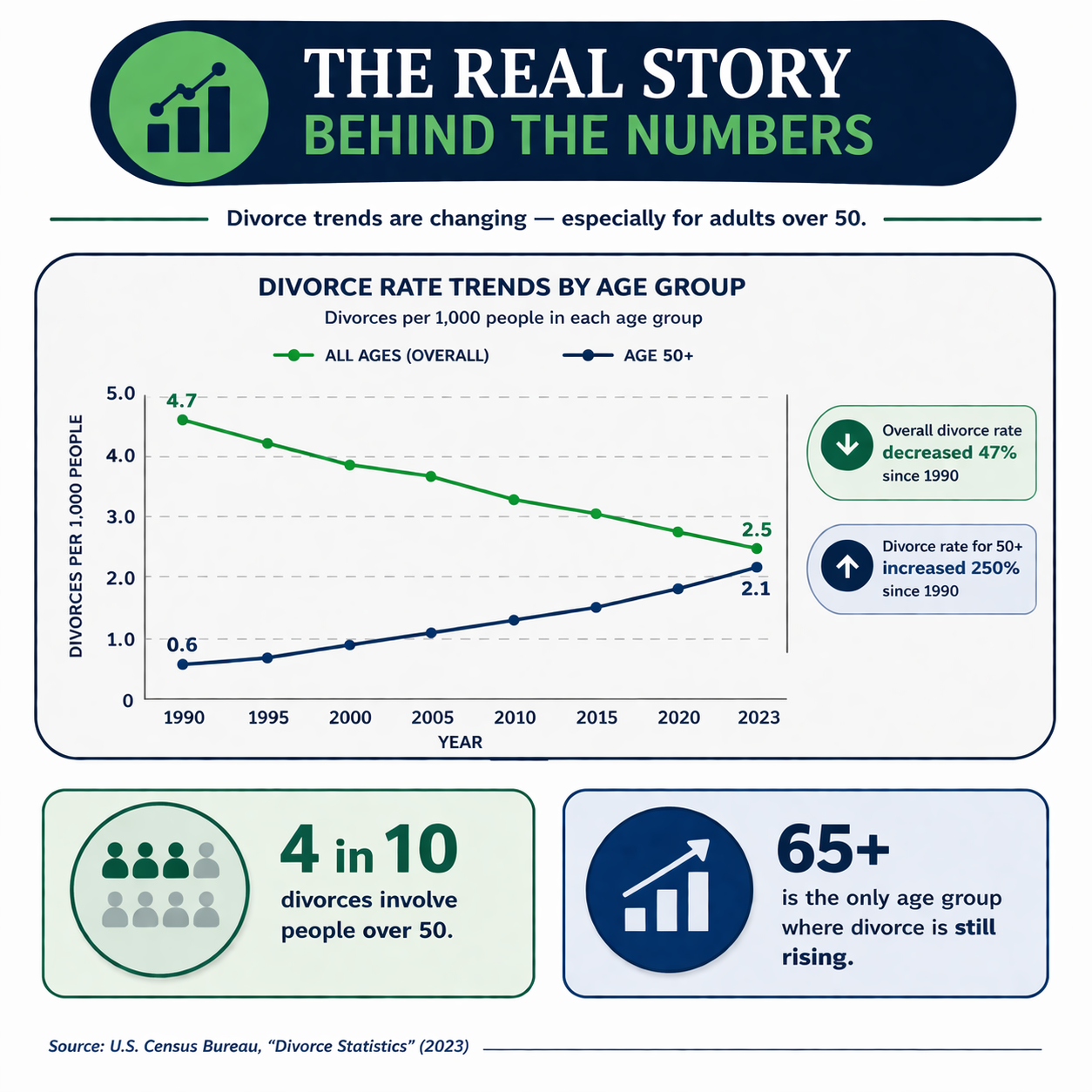
For people 50 and older, the trend is clearly moving upward. Research from Bowling Green State University shows that the 65-plus age group is now the only age group in the country where the divorce rate continues to rise steadily.
One important detail that does not get enough attention is that many of these gray divorces are second or third marriages. Second marriages have a divorce rate of 60 to 67 percent, and third marriages go above 70 percent. Because of this, not all gray divorces are ending 30-year marriages. Many are ending marriages that lasted around 18 years on average. About 15 percent of them end in five years or less.
This adds extra layers of complexity, such as blended families, stepchildren, assets from previous marriages, and different expectations around inheritance.
Why Gray Divorce Feels So Different
Divorcing in your thirties gives you decades to rebuild your career, finances, and social life. When you divorce in your late fifties or sixties, the time to recover is much shorter. Your earning potential is often at or near its peak, and many of your assets are already set.
Financial advisor Scott Hansen put it simply: divorcing after 50 is harder to recover from because you have less time and fewer options to rebuild.
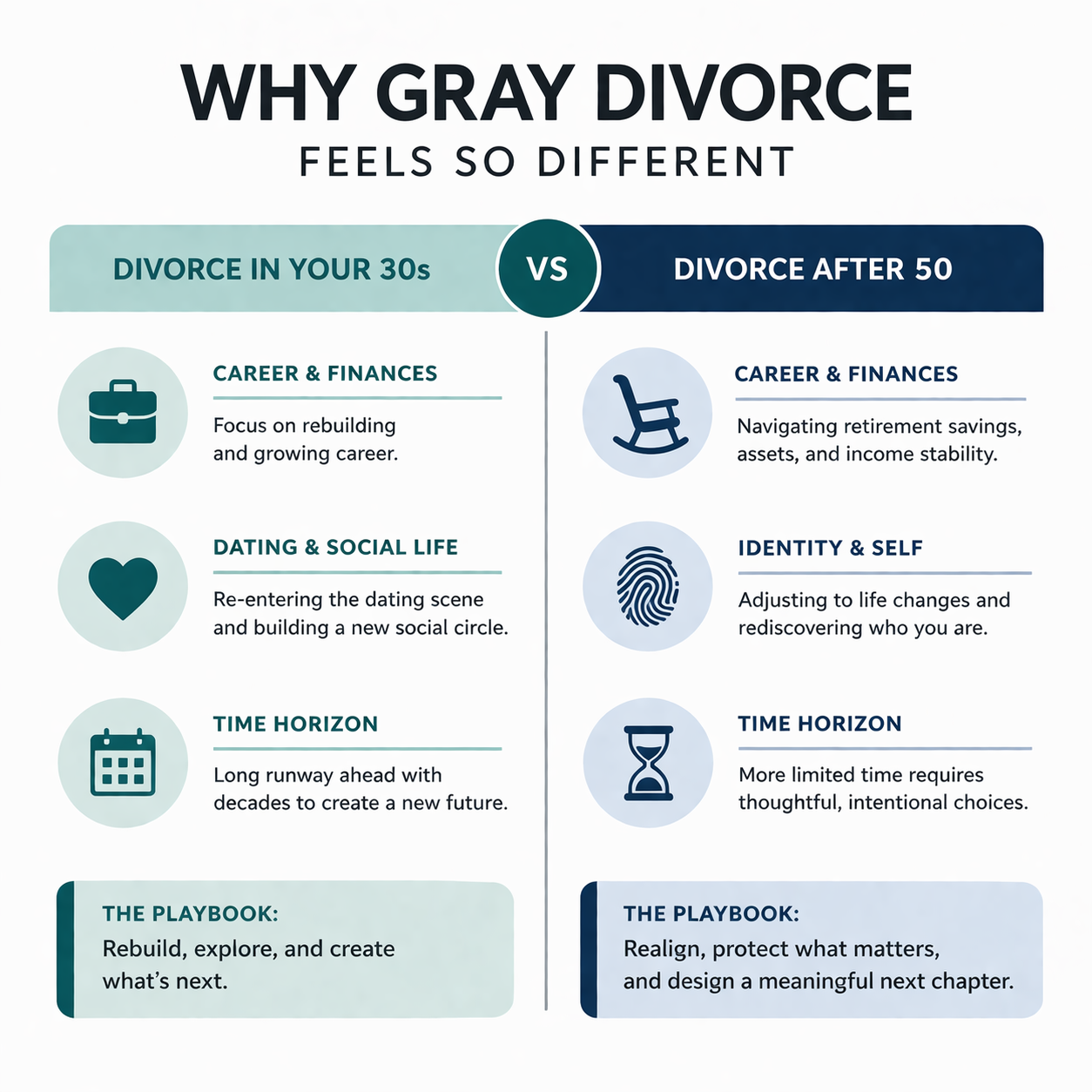
Here are some of the biggest differences:
- Finances that took decades to build are tightly connected. Retirement accounts, pensions, real estate, businesses, and estate plans all need careful untangling.
- Healthcare can become a major concern. If you were covered under your spouse’s plan, losing that coverage before Medicare at age 65 can be very expensive.
- Identity shifts hit hard. After 30 years of being part of a couple, many people suddenly ask themselves, “Who am I on my own?” Studies show that depression symptoms tend to be more severe in gray divorce than in younger divorces.
- Social circles often change dramatically. In many long marriages, women have been the ones keeping family and friend connections alive. When the marriage ends, men in particular can find themselves feeling disconnected from those networks at a time when support matters most.
The Financial Impact Is Significant and Long-Lasting
The numbers are sobering. Research shows that after a gray divorce, men typically see their standard of living drop by about 21 percent. For women, household income often falls between 40 and 45 percent in the first year alone.
Food insecurity and disability risks can increase and stay elevated for six years or more. For women over 63, the risk of falling into poverty can become nearly nine times higher than for those who remain married.
There are several practical financial matters that deserve early attention:
- Retirement accounts such as 401(k)s and pensions usually require a Qualified Domestic Relations Order, or QDRO, to be divided correctly. Getting this paperwork wrong can cost you a large part of your retirement savings.
- Keeping the family home can feel comforting, but it often means giving up other liquid assets. A big house built for two incomes can become a financial strain on one income when you add in taxes, maintenance, insurance, and repairs.
- If you were married for at least ten years, you may be able to claim Social Security benefits based on your former spouse’s record, up to 50 percent of their benefit. The timing of when you claim matters for the rest of your life.
- Divorce costs add up quickly. While the average cost is between $15,000 and $20,000 per person, contested cases can easily run into six figures. Every dollar spent fighting is a dollar taken away from retirement.
One opportunity that many people miss during this process is strategic gifting. While assets are being divided, you may still be able to make tax-free gifts to adult children or grandchildren using the annual gift tax exclusion. You can also make unlimited direct payments for education or medical expenses. Thoughtfully distributing meaningful family items, such as furniture, artwork, or heirlooms, before they become points of conflict can reduce tension and create a positive legacy at the same time.
The Often Overlooked Impact on Adult Children
One of the most important and least discussed parts of gray divorce is how deeply it affects adult children. Even though they are legally adults, the emotional and practical effects can be significant.
Adult children often experience a kind of quiet grief. Their understanding of family stability, holidays, and long-term relationships can feel shaken. Unlike a death in the family, there is usually no ritual or community support to help them process the change. Many feel they are expected to simply accept their parents’ fresh start while they quietly mourn the loss of the family structure they knew.
They may also watch retirement savings get divided, the family home get sold, and legal fees reduce what they once thought might be part of their future inheritance. This can bring complicated feelings of loss, guilt, or even anger, especially if one parent seems more aggressive in the settlement.
Many adult children are in their thirties or forties, raising their own kids and managing busy careers. Suddenly they may be fielding late-night calls, helping with logistics, or trying to split holidays between two households. Some, especially daughters, find themselves stepping into unexpected caregiving roles.
Research shows that after gray divorce, mothers often stay closely connected with their adult children, while fathers can become much less involved if they do not actively reach out. This distance can become permanent without intentional effort.
If you are a parent going through this, the kindest thing you can do for your adult children is to build your own strong support system so they do not carry the full emotional weight. Keep them out of the legal and financial conflicts, avoid speaking negatively about your spouse in front of them, and commit to showing up together for important family events like graduations, weddings, and holidays.
How to Approach Gray Divorce More Consciously
A conscious approach does not mean being passive. It means protecting your own future while trying to minimize unnecessary damage to the people you care about.
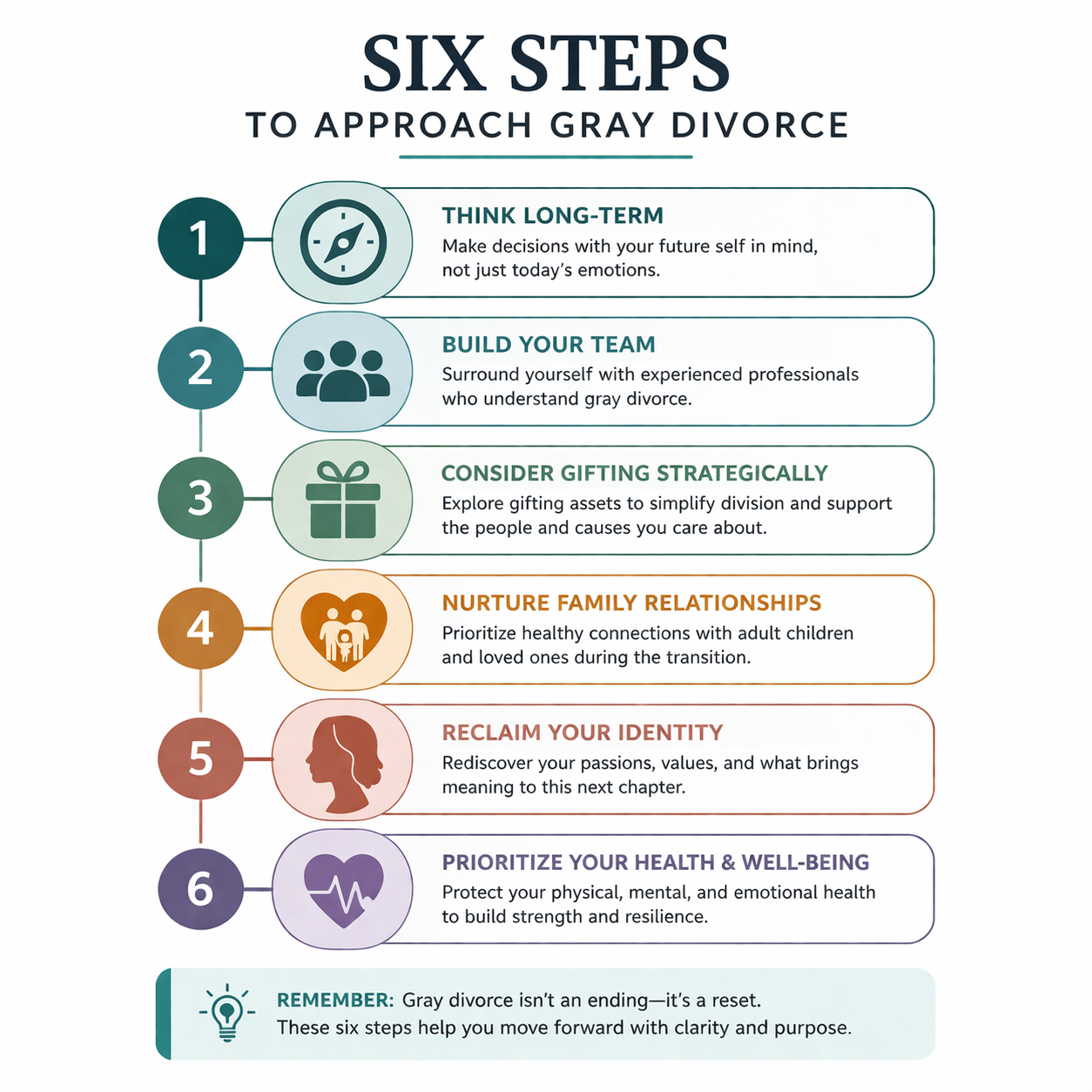
Here are six steps that can make a real difference:
- Think long term. Ask yourself whether you will be glad you made a particular decision when you are 75. Let strategy guide you more than emotion.
- Assemble the right team. Consider working with a divorce coach, an attorney experienced in gray divorce, a Certified Divorce Financial Analyst, and a therapist. Mediation or collaborative divorce can often save money and lead to better outcomes.
- Explore gifting opportunities early. Use this time to pass along meaningful items and make thoughtful transfers where possible.
- Protect your family relationships. Do not put your adult children in the middle. Show them that both parents can still be civil for their sake.
- Rebuild your sense of identity. Take time to figure out who you are outside of the marriage and what you truly want for the years ahead.
- Take care of your health. Sleep, movement, good nutrition, and stress management become even more important during this stressful time. Your body is the foundation for everything else.
A Better Way to See the Story
It is easy to fall into the idea that ending a long marriage means the years were wasted or that it is too late to build something new. That story is simply not true.
A marriage that lasted 30 years was not a failure. It had good seasons and difficult ones. It created children and grandchildren. It helped shape the person you are today. Its ending does not erase everything that came before it.
You are not starting over too late. You are starting forward, bringing with you decades of experience, perspective, and wisdom. Many people in their sixties and seventies go on to find new purpose, new companionship, and a stronger sense of who they really are.
If you are facing gray divorce, supporting someone who is, or simply want to understand this growing trend this book is for you.
You 2.0: Divorce, A Better Way Forward goes surface level advice. It gives you the framework, the neuroscience, and the practical tools to build something most people don’t believe is possible: rebuilding your life and identity after divorce.
Get your copy of You 2.0 and start building what comes next.
Ready to Dive Deeper Into Your Conscious Divorce Transformation?
Explore the complete frameworks and get hands-on tools to accelerate your transformation journey.
Book A Free Strategy Call
30 minute call. No pressure. Just clarity and a plan.
10-minute Divorce Readiness Quiz
Not ready to talk yet? Start here