
When Are You Actually Ready to Date After Divorce?
The Honest Truth Most People Ignore
It’s a quiet Tuesday evening. The kids are with your ex. The house feels too empty. You’ve made dinner for one, half-watched a show, and now your thumb hovers over the “Download” button on a dating app.
In this Conscious Divorce Podcast episode, I share my insights on how to know if you’re truly ready for dating again after divorce.
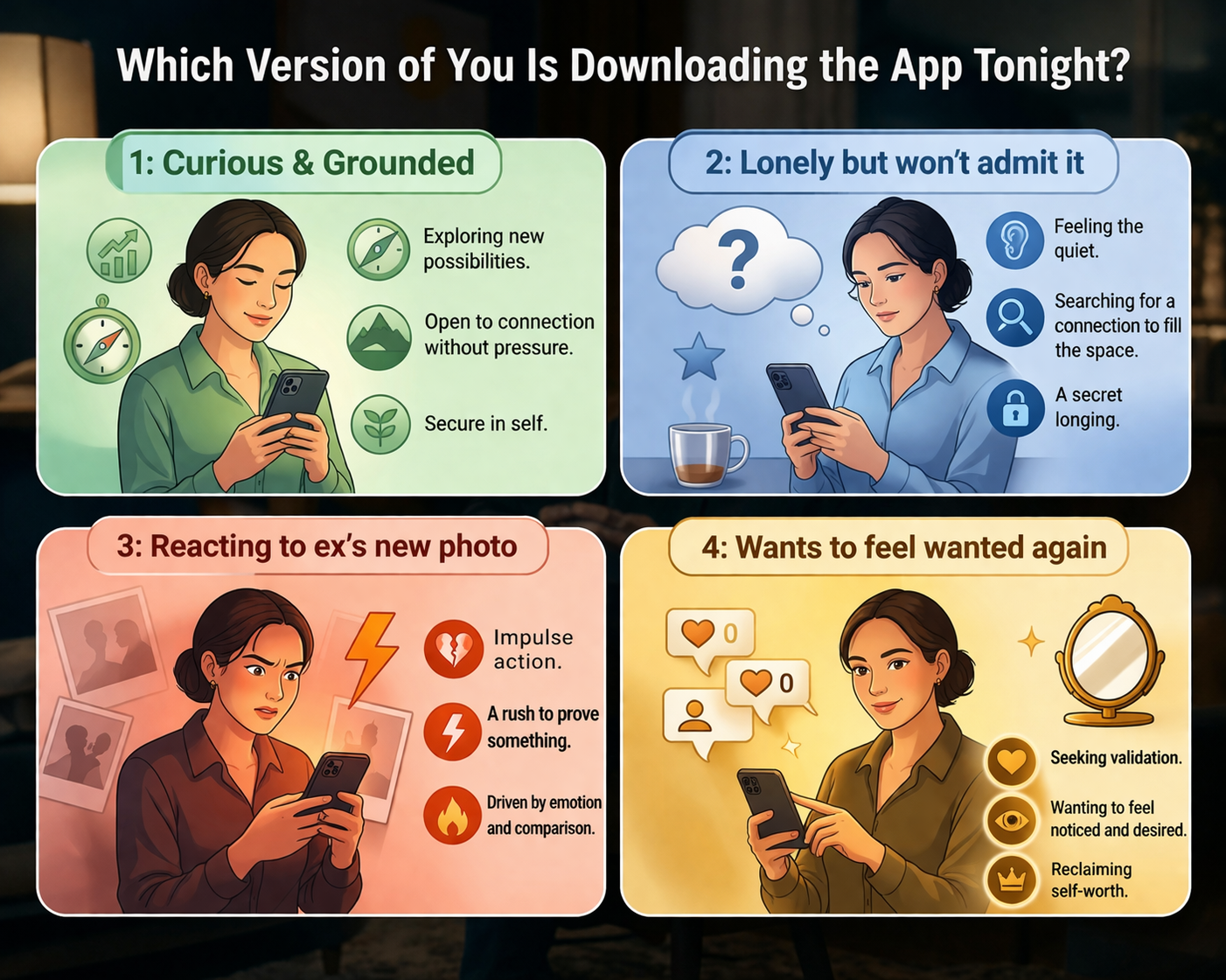
Which version of you is downloading that dating app?
Before you hit download, in that single moment, four different versions of you are fighting for control:
- The version that feels genuinely ready and curious.
- The lonely version that won’t admit it’s lonely.
- The version stung by your ex’s new profile picture.
- The version that just wants to feel wanted and alive again.
All four feel like they are ready. Most of them are not.
This is one of the most important, and most misunderstood, transitions after divorce.
Here’s what almost no one tells you: Without real self-awareness, many people who start dating after divorce are quietly swiping right on the same relationship they just left, only with a different face.
Why “Feeling Ready” Can Be Misleading
Two people can download the same dating app on the same Friday night.
One has spent eight months stabilizing their life. They sleep well, enjoy their own company, and feel genuine curiosity. A relationship would be an addition to a life that already feels like theirs.
The other downloads the app 20 minutes after learning their ex is seeing someone. Their motivation isn’t curiosity, it’s the need to prove they’re still desirable, to avoid feeling left behind, or to distract from pain.
Both will match and go on dates, but they’re operating from completely different emotional foundations. That foundation shapes everything that follows.
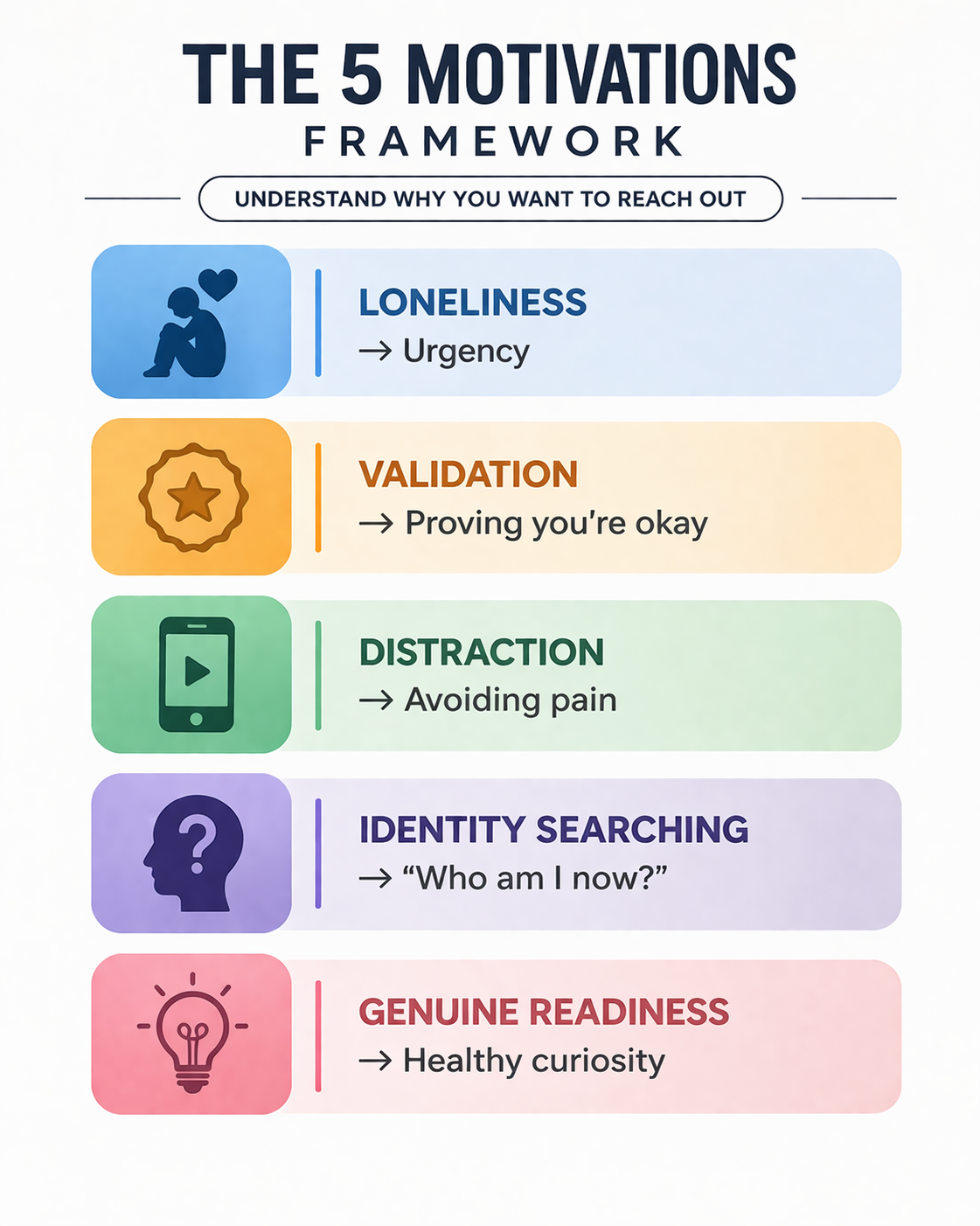
The motivations behind post-divorce dating usually fall into five categories:
- Loneliness — Real and valid, but dangerous when it creates urgency and you mistake relief for connection.
- Validation — The need to prove you’re still wanted (this one is sneaky because it can look like readiness from the outside).
- Distraction — Using dating to avoid sitting with difficult feelings.
- Identity searching — Hoping a new relationship will tell you who you are now.
- Genuine readiness — Curiosity that comes from a stable, grounded place.
A powerful reflection question I give every client:
If no one showed romantic interest in you for the next 12 months, what part of that would feel most uncomfortable?
Your honest answer reveals far more about your readiness than how much time has passed since your divorce.
The Neuroscience Behind Poor Post-Divorce Decisions
Grief is not just emotional, it’s neurobiological. Divorce, especially high-conflict ones, activates the same stress systems as trauma. Chronic stress floods the body with cortisol, impairing the prefrontal cortex (responsible for long-term thinking and emotional regulation) while over-activating the amygdala (threat, craving, and urgency responses).
Research shows that acute stress impairs complex decision-making, exactly what’s needed to evaluate a new partner. A 2025 study found elevated cortisol linked to heightened risk-taking, poor judgment, and mistaking short-term relief for genuine connection.
Calm does not automatically mean healed. Many people date from a place of “fine” and later realize they were still carrying unresolved patterns. Full emotional integration after divorce typically takes 2–3 years for most people (shorter with professional support). You don’t necessarily need to wait that long, but honest self-assessment is essential.
The Mirror Problem and Pattern Gravity
Studies, including research published in PNAS and Social Sciences, show that people often choose new partners with personality traits similar to their ex, sometimes strikingly so.
This is what I call “pattern gravity”, the unconscious pull toward familiar emotional dynamics, even when those dynamics were painful. Your nervous system is wired for what’s known, not necessarily what’s healthy.
The good news? Research supports the “learning hypothesis”, intentional reflection and deliberate effort can change these patterns. Repetition is the default, not destiny.
Healthy attraction often feels calmer than what you’re used to. If you came from high-conflict or high-intensity dynamics, genuine stability and emotional availability can initially feel “boring.” Expanding your definition of chemistry is some of the most important inner work you can do.
Treat Your Past Relationship as Data Not Just a Wound
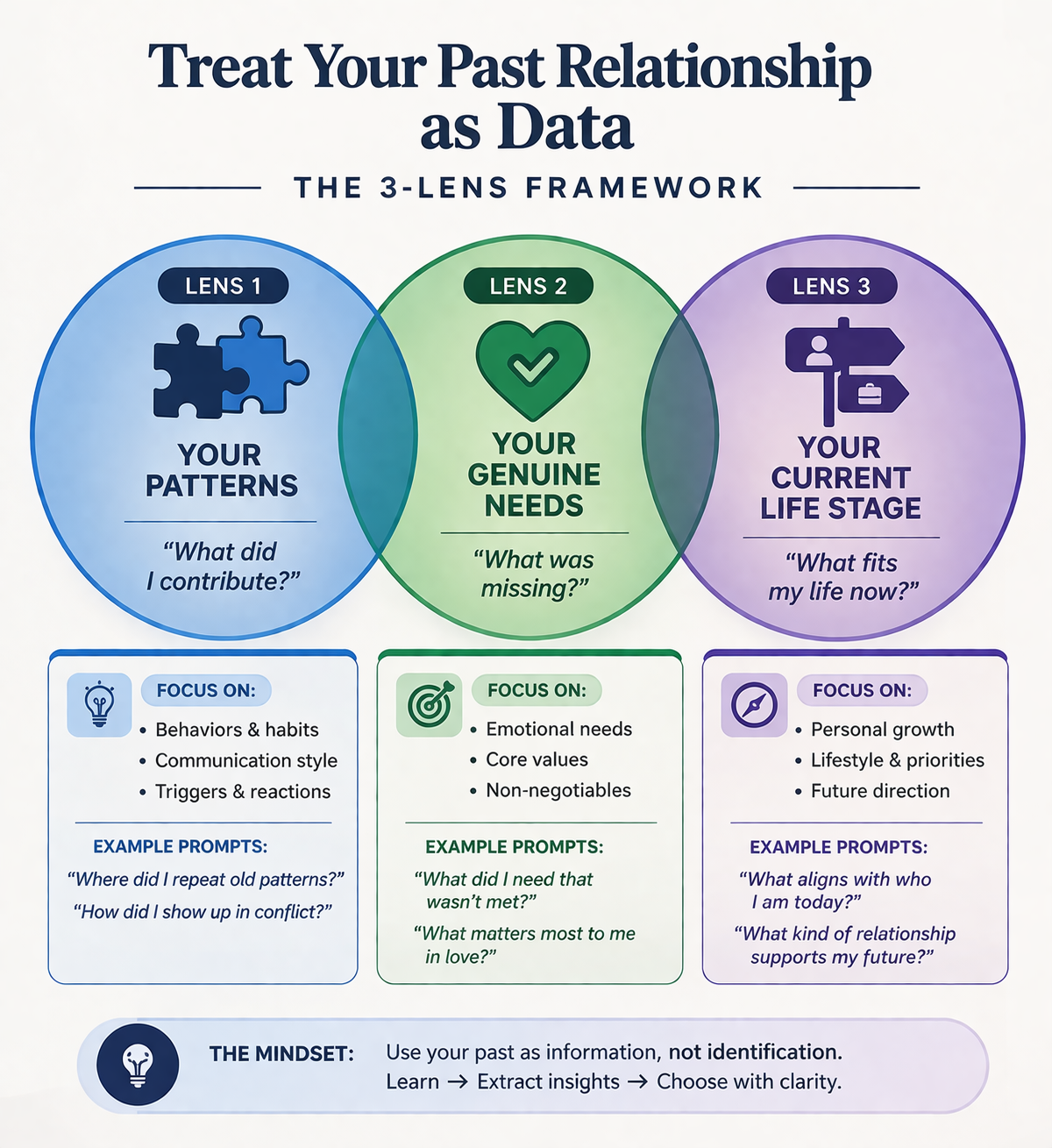
Instead of replaying your marriage as blame or self-failure, treat it as valuable data using this three-lens framework:
Lens 1: Your own patterns
What did you do (or not do) when things got difficult? Did you accommodate, avoid conflict, expect your partner to read your mind, or wait and hope things would improve? Identify your behavioral contributions, not for self-blame, but for preparation.
Lens 2: Your genuine needs
What was consistently missing? Emotional presence? Accountability? Respectful conflict? Affection given freely? Naming these clearly is not complaining about your ex, it’s being honest about what you actually need now.
Lens 3: Your current life stage
You’re not the same person you were when you got married. What kind of relationship fits the life you actually have now, with kids, different finances, new priorities, and clearer boundaries?
Putting these three lenses together gives you an honest, personalized starting point far more useful than any dating app algorithm.
Building Your Non-Negotiables List
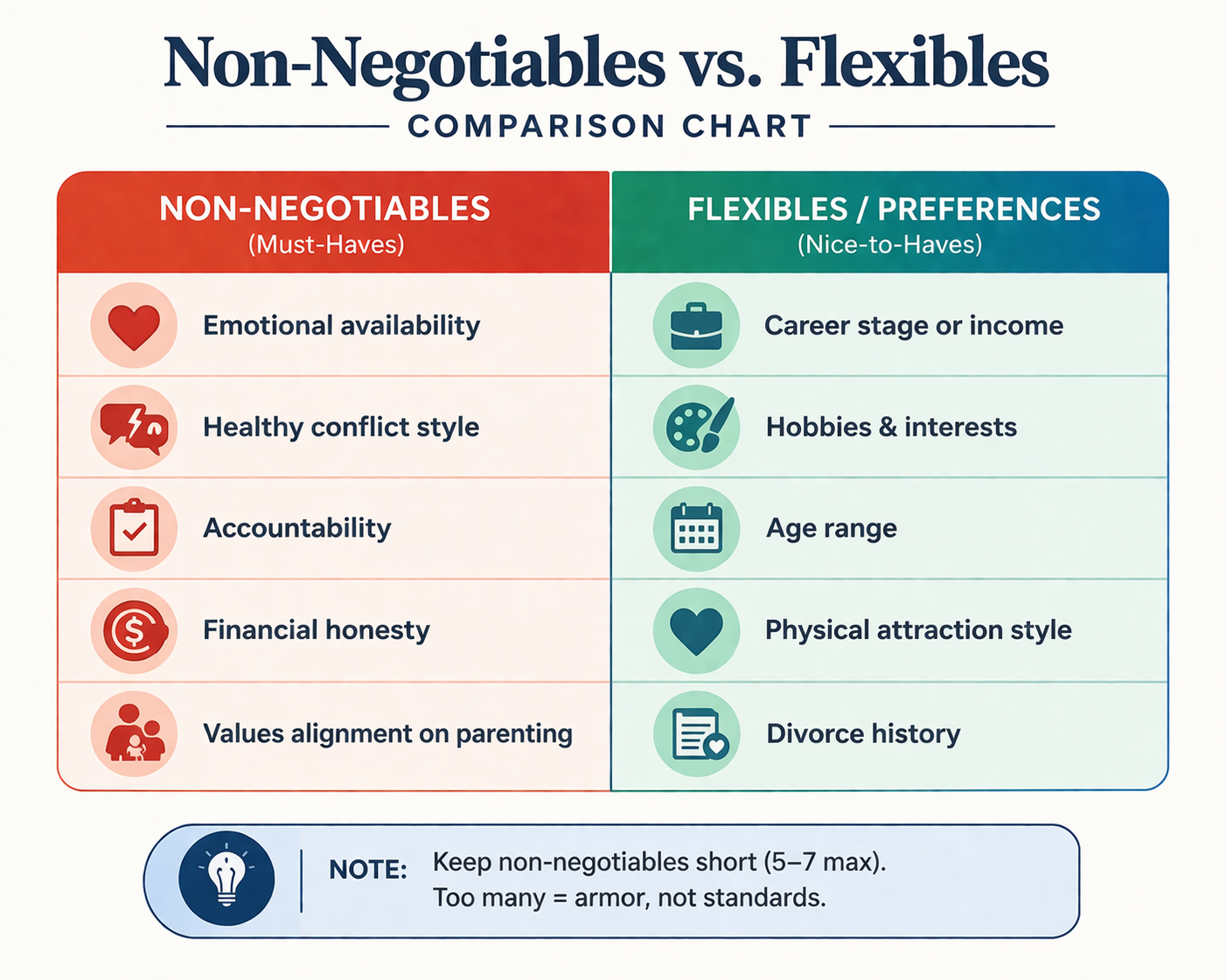
Non-negotiables should be short (5–7 items maximum), specific, and behavior-based. Examples include:
- Emotional availability and accountability
- A healthy, respectful approach to conflict (no contempt, stonewalling, or defensiveness, per Gottman Institute research)
- Financial honesty and responsibility
- Values alignment around parenting (if you have children)
Preferences (flexibles) include career stage, income level (within reason), hobbies, or age range. These matter, but they shouldn’t be absolute deal-breakers.
Revisit both lists every six months. Who you are and what you need evolves.
Dating with Kids: A Different Set of Rules
When children are involved, you’re managing three interconnected relationships: with your kids, your co-parent, and any new partner.
Children often hold reunification fantasies for 1–3 years after divorce. Introducing a new partner too soon can trigger grief responses misread as rejection.
Clinical consensus recommends waiting 9–12 months into a new relationship before introductions. Tell your co-parent first to protect your kids from surprise conflict. In high-conflict co-parenting situations, extra caution and professional support (therapist or coach) are often necessary.
What Genuine Readiness Actually Looks Like
Readiness isn’t a feeling, it’s a state:
- You can think about your ex without emotional flooding
- You’re genuinely comfortable with your own company
- You’ve taken honest accountability for your role in what happened
- You trust what you observe in others over time
- You feel curiosity more than desperation or validation-seeking
- A new relationship would add to a life that already feels like yours
Final Thoughts
That quiet Tuesday evening when your thumb hovers over the dating app, pause. Ask yourself: Which version of me is making this decision right now? And do I truly know what I’m looking for?
Pattern gravity is real. The mirror problem exists. But neither has to be your destiny.
Clarity is the difference between repeating the past and creating something healthier and more fulfilling.
If you’re navigating this chapter, I’d love to hear from you in the comments:
What’s one insight you’ve had about your own readiness (or unreadiness) to date again after divorce?
For more support, visit reclaimandreboot.me for one-on-one coaching, my free Divorce Readiness Quiz, or my books You 2.0: Divorce; A Better Way Forward and the companion workbook.
You are not alone in this. I’m rooting for your future.
If you're co-parenting through divorce, this book was written for you.
You 2.0: Divorce, A Better Way Forward goes beyond the legal agreements and scheduling apps. It gives you the framework, the neuroscience, and the practical tools to build something most people don’t believe is possible: a co-parenting relationship where your children don’t just survive the divorce, they thrive because of how you navigated it.
Chapter 14 alone is worth the read. It walks you through the Five Pillars of Masterful Co-Parenting, a proven structure that transforms daily conflict into conscious collaboration, grounded in Dr. Daniel Siegel’s research on how your emotional climate is literally shaping your children’s developing brains right now.
But You 2.0 doesn’t stop there. Because your children aren’t just watching how you co-parent. They’re watching how you live. This book gives you both: the co-parenting strategies to protect them, and the personal transformation tools to become the parent they need you to be.
Your marriage ended. Your family didn’t. And the way you move forward matters more than you know.
Get your copy of You 2.0 and start building what comes next.
Ready to Dive Deeper Into Your Conscious Divorce Transformation?
Explore the complete frameworks and get hands-on tools to accelerate your transformation journey.
Book A Free Strategy Call
30 minute call. No pressure. Just clarity and a plan.
10-minute Divorce Readiness Quiz
Not ready to talk yet? Start here