
When Divorce Is the Best Decision: How to Rebuild Your Life
By: Justin Milrad – CDC Certified Divorce Coach®, Marriage and Relationship Coach, MBA, Financial Planner
Sometimes the hardest part of divorce is accepting that a marriage can matter deeply and still no longer work. The opportunity is not to romanticize the ending, but to use it as a turning point for clearer choices, healthier patterns, and a life that feels more honest.
What You'll Learn
- How to tell the difference between working on a marriage and simply enduring it
- Why the appearance of a successful marriage can hide a very different private reality
- How to reframe divorce as a transition without minimizing its pain or consequences
- Why honest self-examination matters more than assigning blame
- How Justin Milrad's “You 2.0” framework can turn a difficult ending into deliberate personal growth
When the Marriage Looks Better From the Outside
One of the most confusing parts of deciding whether to divorce is that the life other people see may have very little to do with the life you are actually living. Justin Milrad describes his own marriage as one that appeared successful from the outside. He and his former spouse were raising three children, building a business together, and sharing a mission that mattered to both of them.
That history was real. So was the growing disconnection.
Justin did not describe divorce as his first response to difficulty. He read, suggested therapy, initiated conversations, and tried to repair the relationship. Eventually, however, he reached a conclusion that many people resist because it forces them to separate hope from evidence: wanting a relationship to recover is not the same thing as seeing that recovery actually happen.
“Wanting something to work and it actually working are two completely different things.”Justin Milrad
That does not mean every unhappy season points toward divorce. Marriage requires communication, compromise, recalibration, and sustained effort. A difficult period can be temporary. But there is a meaningful difference between two people working through a hard season together and two people repeatedly circling the same unresolved problems while becoming more disconnected.
The Hamster Wheel: Motion Without Progress
Justin uses the image of a hamster wheel to describe relationships that are full of activity but short on movement. The couple still handles schedules, dinners, bills, school events, and ordinary conversations. Life continues to function. Yet neither person feels that the relationship itself is growing.
This is where longevity can become a misleading measure of success. Staying married for another year does not automatically mean the relationship became healthier during that year. The more useful questions are whether both people are able to communicate honestly, whether there is mutual respect, whether difficult issues can be addressed, and whether both partners are still choosing the relationship rather than merely maintaining its structure.
Are you putting energy into repairing the relationship, or mostly putting energy into preserving the appearance, routine, or expectations surrounding it?
For Justin, the turning point was not simply deciding that the marriage had problems. It was becoming willing to acknowledge what those problems meant, including his own role in them. He describes having checked out emotionally, avoided difficult conversations, and prioritized keeping the peace over speaking honestly.
That distinction matters. Divorce can easily become a story in which one person is the villain and the other is the victim. Sometimes serious wrongdoing is part of the story, and accountability for harmful behavior should not be blurred. But personal growth still requires asking a separate question: what patterns, choices, or avoidances are mine to understand and change?
Divorce as an Honest Transition
Divorce is painful even when it is the right decision. Justin remembers packing a life into boxes, moving into an apartment, and grieving not only the relationship but the future he had imagined. The end of a marriage can involve the loss of routines, identity, financial assumptions, friendships, traditions, and a picture of the family that once felt permanent.
The reframe is not that those losses do not matter. It is that the legal ending does not have to be the end of personal agency. Once the old structure changes, you have to make choices that marriage may have allowed you to postpone: Who are you now? What do you want your days to look like? Which patterns do you refuse to repeat? What kind of parent, partner, friend, or professional do you want to become?
Justin calls that next version “You 2.0.” It is not a reinvention based on pretending the past never happened. It is an upgrade built from what the past taught you. His framework centers on four practices: self-awareness, self-compassion, accountability, and growth.
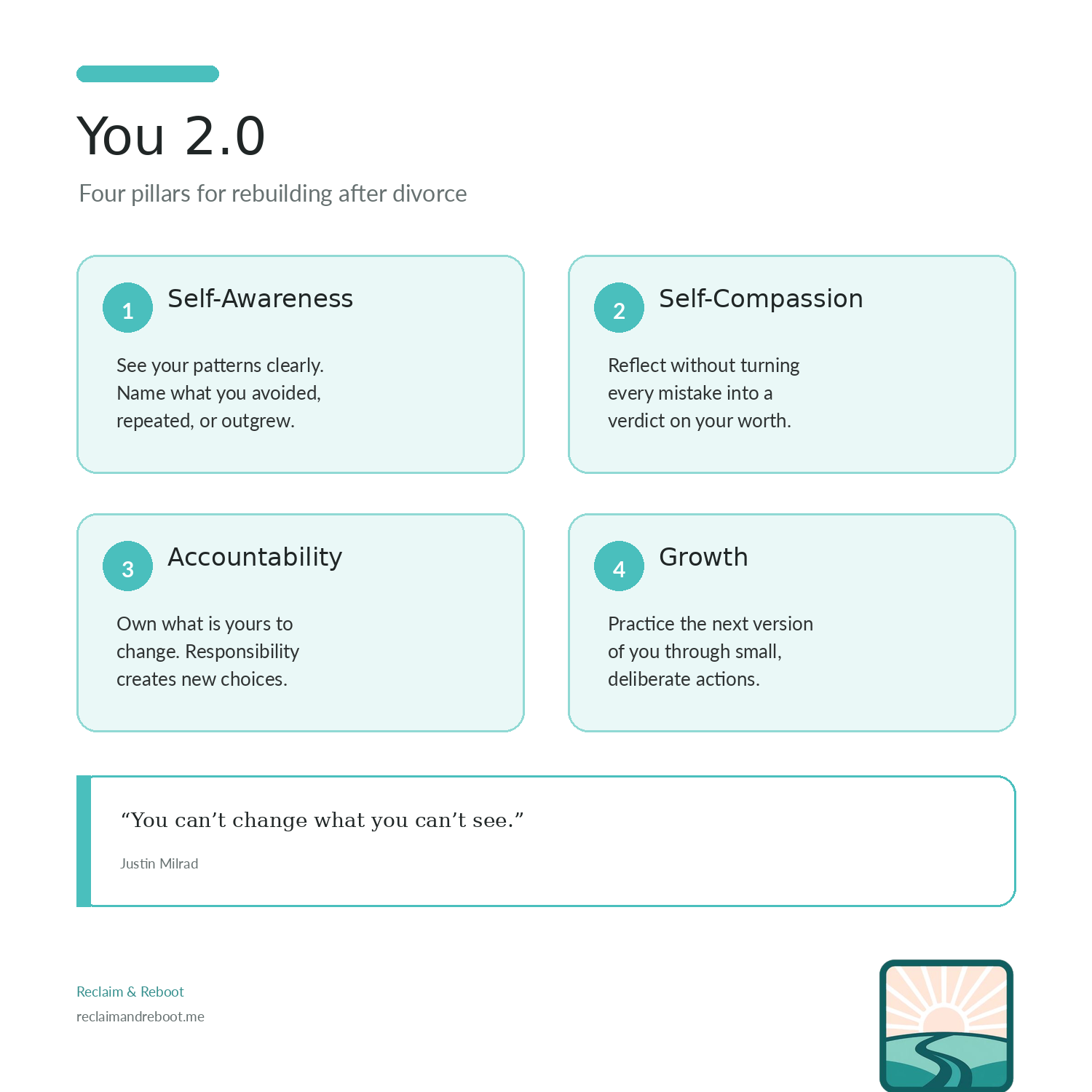
The Four Pillars of You 2.0
Justin's framework is useful because it gives the rebuilding process somewhere to go. Instead of defining yourself only by what ended, you can focus on the capacities you want to strengthen next.
1. Self-awareness
Self-awareness begins with questions that may be uncomfortable but are still productive: Where did I contribute to the breakdown? What patterns did I bring into the marriage? What conversations did I avoid? What was I tolerating, performing, or pretending not to notice?
The purpose is not to manufacture equal blame. It is to identify what belongs to you because that is the part you can actually change. As Justin puts it, “You can't change what you can't see.”
2. Self-compassion
Honest reflection becomes destructive if every insight turns into another reason to attack yourself. Self-compassion allows you to acknowledge mistakes without making those mistakes your identity. You can regret a decision and learn from it without concluding that you are permanently defined by it.
3. Accountability
Accountability keeps compassion from becoming excuse-making. It means owning the communication habits, avoidance, resentment, withdrawal, or boundary failures that you do not want to carry into your next chapter.
For Justin, recognizing the ways he had withdrawn and chosen silence over difficult truth was empowering precisely because those behaviors were changeable. Accountability moved the story from “this happened to me” toward “I have choices about how I respond now.”
4. Growth
Growth is where the previous three pillars become visible in everyday life. It may mean learning to sit with discomfort rather than reacting, setting a boundary you previously avoided, returning to a neglected interest, taking better care of your body, or communicating more directly.
Ask: What would my You 2.0 self thank me for doing today? Choose one concrete action, not a complete life overhaul.
What This Reframe Means for Parents
Parents often carry an additional fear: if the marriage ends, the children will inevitably be damaged. The research is more nuanced. Children's responses to divorce vary considerably, and studies have repeatedly identified factors such as interparental conflict, parenting quality, economic stress, and the broader family environment as important influences on adjustment.
A 2020 meta-analysis covering 115 samples and 24,854 divorced families found meaningful links among interparental conflict, parenting behaviors, and children's psychosocial adjustment. That does not mean conflict is the only factor, and it does not make divorce harmless. It does mean that the quality of family relationships before and after separation matters greatly.
That point strengthens one of Justin's most useful ideas while also putting needed boundaries around it. The goal is not to prove that children are “better off” after divorce. The goal is to create the healthiest post-divorce family environment possible: lower unnecessary conflict, avoid making children emotional intermediaries, communicate predictably, and keep the focus on their needs rather than on winning against the other parent.
“You have to put your kids' needs ahead of your own resentment, disappointment or hurt.”Justin Milrad
In Justin's experience, co-parenting became a daily practice ground for emotional maturity. Instead of treating every text as a potential battle, he worked on staying calm, communicating clearly, and returning the focus to the children. The relationship had changed form, but it still required intentional behavior.
You 2.0: Divorce; A Better Way Forward
I thought my divorce would destroy me. Instead, it became the catalyst for creating a life more authentic and purposeful than I’d ever imagined possible.
You 2.0 is the blueprint I wish I’d had. Born from my own messy journey and refined through coaching others from survival to transformation. This isn’t about picking up the pieces of your old life. It’s about becoming the architect of something entirely new
Three Questions to Start Rebuilding
You do not need to know what the next five years will look like before you can begin moving forward. Justin recommends starting with reflection that turns vague discomfort into something you can actually examine.
- Where are you still on the hamster wheel? Identify the places where you are spending energy out of fear, obligation, habit, or image without creating meaningful progress.
- What part of your identity are you ready to retire? It may be the perfect spouse, the person who never asks for help, the peacekeeper, the martyr, or another role that no longer fits.
- What would your future self thank you for doing today? Choose one boundary, conversation, appointment, decision, or healthy routine that moves you toward the person you want to become.
Small choices matter because rebuilding is not a dramatic reveal. It is practice. It is telling the truth sooner, reacting less impulsively, protecting time that matters, getting professional help when you need it, and refusing to recreate the same patterns in a different relationship.
Do Not Confuse an Emotional Reframe With a Divorce Plan
Seeing divorce differently does not remove its legal, financial, or parenting consequences. If you are still deciding what to do, pair emotional clarity with practical preparation. Understand your finances, gather important records, learn what questions require an attorney or other qualified professional, and think carefully about what stability will look like for your children.
If you are at that stage, Reclaim & Reboot's guide to preparing for divorce can help you organize the practical questions alongside the emotional ones. Parents navigating an existing separation may also find the co-parenting boundaries guide useful for keeping communication more structured and child-focused.
Divorce is not automatically a failure, and it is not automatically a fresh start. What matters is what you do with the transition. If repair is still possible and healthy, give it serious effort. If the marriage truly cannot be rebuilt, the work becomes ending it as thoughtfully as possible and refusing to waste what the experience can teach you.
Justin's “You 2.0” idea is ultimately less about divorce than about agency. A
Reclaim → Reboot → Become YOU 2.0
Divorce is too important to figure out as you go.
Reclaim & Reboot helps people prepare for the legal, financial, parenting, and personal decisions that come with divorce so they can make better use of their professional team and move forward with greater clarity.
Book a strategy call with before your next attorney meeting or major divorce decision.
Book A Free Strategy Call
30 minute call. No pressure. Just clarity and a plan.
Reserve Your Intensive Session
Prepare yourself for all high-stakes divorce situations.