
Why Every Divorced Parent Needs a Playbook
Divorce may end a marriage, but when children are involved, it does not end the relationship between two parents. The legal process can create an agreement, assign parenting time, divide assets, and define responsibilities, but it does not automatically teach two people how to communicate, manage conflict, share decisions, or protect their children from the emotional weight of the divorce. That is where so many parents find themselves stuck. The court order may be finished, but the day-to-day reality of co-parenting is just beginning.
This is one of the most difficult truths divorced parents face. You can sign the papers, move into separate homes, and begin rebuilding your own life, but then your child asks which house their soccer cleats are at, who is picking them up from practice, whether both parents are coming to the school event, or why one parent seems angry at the other. In those moments, the divorce is no longer just a legal event. It becomes a daily system your child has to live inside. The question is whether that system creates stability or chaos.
That is why co-parenting cannot be left to emotion, hope, or improvisation. Parents need structure. They need language they can use when they are triggered. They need boundaries that protect the children without creating unnecessary war. They need tools for scheduling, money, school decisions, medical decisions, high-conflict communication, and the painful moments when one parent refuses to cooperate. Most of all, they need a child-first approach that keeps adult conflict where it belongs: away from the kids.That is the heart of my conversation with Jill Kaufman on The Conscious Divorce Podcast and it is also the reason we wrote The Co-Parenting Playbook: Proven Strategies for Navigating Divorce, Conflict, and Raising Thriving Kids.
Jill brings more than 20 years of experience as a licensed therapist, divorce coach, mediator, co-parenting expert, and parent educator. I bring my own professional background as a Certified Divorce Coach, financial planner, marriage and relationship coach, and someone who has personally gone through divorce and learned many of these lessons the hard way. Together, we wanted to create a practical guide that parents could return to again and again when emotions are high and the next right step is not obvious.
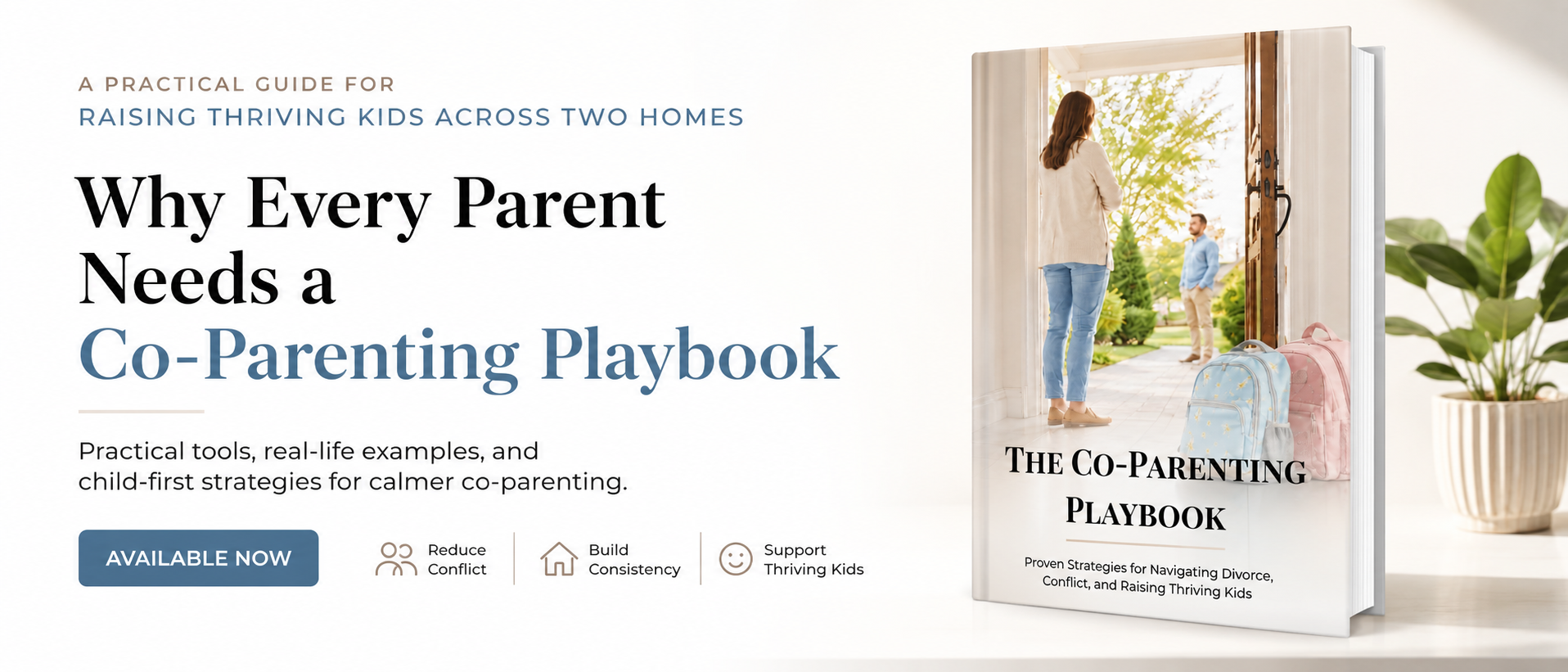
Co-Parenting Is Not About Being Friends With Your Ex
One of the biggest misconceptions about co-parenting is that it requires friendship. It does not. Friendship may happen for some former spouses, and when it does, that can be a wonderful thing. But friendship is not the standard. The standard is respect, consistency, communication, and emotional discipline. A parent does not need to like their ex to protect their child. They do not need to agree with every decision in the other home. They do not need to pretend the marriage was healthy, easy, or painless. They do need to stop making the child responsible for the emotional residue of the marriage.
In the episode, we talk about co-parenting as a business partnership with the highest possible stakes. That may sound clinical at first, especially to someone still raw from divorce, but it is often the most useful way to think about the relationship. You and your co-parent are no longer romantic partners. You may not even be friends. But you are still connected through the most important project of your lives: raising emotionally healthy children across two homes.
A business partnership requires clarity and documentation. It requires professionalism when personal feelings are present. It requires each person to understand the objective and make decisions based on that objective, not based on who is angry, who is hurt, or who wants to be right. In co-parenting, the objective is your child’s wellbeing. That means every text, every schedule change, every financial request, every school decision, and every handoff should pass through one filter: does this serve my child?
That filter sounds simple but it is not always easy. Divorce can leave people feeling betrayed, dismissed, afraid, resentful, or desperate to regain control. Those feelings are real, and they deserve support. But they do not belong in front of the children, and they should not drive co-parenting decisions. A co-parenting playbook helps parents separate what they feel from how they act. That distinction can change a lot.

The Divorce Is Not Always What Hurts Children Most
Many parents carry enormous guilt about divorce. They worry that the divorce itself will damage their children forever. That fear is understandable, but it is incomplete. Research and clinical experience continue to point to a more specific danger: ongoing parental conflict. Children can adjust to two homes. They can adapt to different routines, different bedrooms, different calendars, and different household styles. What they struggle to absorb is chronic tension between the adults they love.
When children are repeatedly exposed to conflict, they can begin to feel unsafe, responsible, divided, or forced to choose sides. They may become messengers between homes. They may learn to monitor each parent’s mood before speaking. They may hide parts of their life to avoid upsetting one parent. They may stop sharing honestly because every detail feels like it could become evidence in another adult argument. This is not what children are built to carry.
A peaceful divorce can be healthier for a child than a hostile marriage. That is a difficult sentence for many parents to accept, but it matters. The structure of the family is not the only factor. The emotional climate of the family matters deeply. A child who moves between two calm, stable homes can often do far better than a child living in one home filled with tension, contempt, or constant fighting.
This is why parents need a plan.
Good intentions are not enough when emotions are high. A parent may genuinely love their child and still speak badly about the other parent within earshot. A parent may want peace and still send a reactive text that turns into three days of conflict. A parent may believe they are protecting their child and still pull them into adult information they should never have had to hold. The playbook is there for the moments when love is present, but regulation and structure are missing.
Communication Is Where Most Co-Parenting Breaks Down
Most co-parenting problems do not begin with huge legal violations. A text is read with the wrong tone. A pickup time changes. A child reports something from the other house. A reimbursement request feels like an accusation. One parent asks a simple question, and the other hears criticism. Before long, two people are no longer discussing the child’s needs. They are back inside the old relationship dynamic.
That is why communication has to become more intentional after divorce. Parents need to learn how to pause before responding, stay factual, use neutral language, and avoid giving conflict more oxygen than it needs. This is not about becoming cold or robotic. It is about becoming steady. Children benefit when their parents can exchange information without turning every issue into a referendum on marriage.
In the book and in the episode, we talk about the BIFF method: brief, informative, friendly, and firm. BIFF is especially useful when conversations can easily become emotional or defensive. The goal is not to win an argument. The goal is to exchange necessary information while reducing the opportunity for escalation. A long message filled with explanation may feel satisfying in the moment, but it often creates more surface area for conflict. A shorter message that stays focused on the child is usually more effective.
For example, if a co-parent sends a message saying, “You’re always late picking up the kids. It’s disruptive and shows you don’t care about their schedule,” the instinct may be to defend yourself, correct the record, bring up the other parent’s mistakes, or prove that their accusation is unfair. A BIFF-style response would be much simpler: “I will pick up the kids at 5:00 PM today as scheduled. If anything changes, I will let you know in advance. Thanks.” That response does not take the bait. It does not escalate. It does not surrender your boundary. It simply returns the conversation to the child and the schedule.
This kind of communication takes practice. It can feel unnatural at first, especially if your previous pattern involved defending, explaining, reacting, or trying to get the other person to finally understand your point of view. But co-parenting communication is not the place to process the marriage. It is the place to manage the responsibilities that remain.
You Have to Regulate Before You Communicate
No communication tool works if your nervous system is already in fight-or-flight mode. This is one of the most important points Jill and I discussed. When a message from your ex activates you, your body may respond as if you are in danger. Your heart rate increases. Your thoughts speed up. Your brain starts preparing for battle. In that state, it is very difficult to write a calm, child-focused response.
Many parents think the problem is that they do not know what to say. Often, the deeper problem is that they are trying to respond before they are regulated enough to think clearly. That is why the first step is not drafting the perfect text. The first step is putting the phone down, breathing, walking, drinking water, journaling, calling a grounded friend, or giving yourself time before you hit send.
Regulation is not avoidance. A parent who pauses before responding is not weak. They are choosing effectiveness over impulse. They are choosing their child’s stability over their own immediate need to defend or retaliate. Over time, that choice becomes a new pattern, and that new pattern can reduce conflict dramatically.
The book includes practical techniques parents can use before responding, including breathing exercises, thought work, grounding practices, and visualization tools. These may seem small, but in real co-parenting situations, small pauses can prevent large conflicts. One regulated response can stop a fight before it begins.
Consistency Matters More Than Perfect Agreement
Children are not built for chaos. They are built for rhythm. After divorce, they are already adjusting to a major change in family structure, and the more predictable their world becomes, the safer they tend to feel. That does not mean both homes need to be identical. It does mean parents should align on the areas that most directly affect the child’s stability.
In the book, we make an important distinction between what should stay relatively consistent and what can differ between homes. Bedtime windows, school routines, homework expectations, medical protocols, screen safety, respectful behavior, and major discipline values often benefit from alignment. Other things, such as meals, weekend activities, room decor, chore systems, allowance, and extended family traditions, may differ without harming the child.
This distinction matters because many co-parents fall into one of two traps. Some try to control everything that happens in the other house, which usually creates more conflict and resentment. Others give up entirely and decide that consistency is impossible, which can leave children without enough structure. The goal is not control. The goal is stability.
The painful truth is that you cannot control the other home. You may disagree with how your co-parent handles routines, rules, money, activities, or discipline. Some of those differences may be frustrating but not necessarily harmful. Others may be serious and require documentation, professional support, or legal intervention. Part of mature co-parenting is learning to tell the difference.
If your co-parent will not cooperate, your influence still matters. A stable home with predictable routines, emotional safety, clear expectations, and a parent who remains grounded can have a powerful impact on a child. One steady parent can make a difference.
Not Every Situation Calls for Traditional Co-Parenting
There are situations where cooperative co-parenting is not realistic. Some co-parents are consistently provocative, controlling, manipulative, unreliable, or unwilling to communicate in a child-centered way. In these cases, the goal may need to shift from collaboration to containment. That is where parallel parenting becomes necessary.
Co-parenting is collaboration. Parallel parenting is structured disengagement. It reduces the amount of direct interaction between parents while still allowing both to remain involved in the child’s life. Communication may happen only in writing. Exchanges may occur at school or neutral locations. Each parent may run their household independently with minimal discussion. Decisions may be handled through a more formal process, and documentation becomes especially important.
Parallel parenting is not failure. For some families, it is the healthiest available structure. If every attempt at cooperation turns into conflict, the child does not benefit from more forced interaction between the parents. The child benefits from less exposure to tension. The purpose of parallel parenting is not to punish the other parent or withdraw from responsibility. It is to protect the child from being placed in the middle of repeated adult conflict.
A co-parenting playbook needs to include this reality because not every family is dealing with two reasonable adults who can sit down and work through issues calmly. Some parents are dealing with high-conflict personalities. Some are dealing with coercive control, financial manipulation, legal harassment, or repeated boundary violations. Those parents need a different set of tools. They need structure, documentation, support, and clear limits.
Children Should Never Become Messengers, Mediators, or Emotional Caretakers
One of the most damaging patterns in divorce is putting children in the middle. Sometimes this is obvious, such as asking a child to deliver a message, report on the other parent, or take sides in a dispute. Other times, it is subtle. A parent may ask too many questions about the other home, make a sarcastic comment, vent within earshot, or respond emotionally when the child shares something ordinary about the other parent.
Children notice more than adults think they do. They hear tone. They see facial expressions. They feel tension. They know when a parent is upset after a phone call or text exchange. Even when adults believe they are hiding conflict, children often sense it and may begin adjusting their behavior to manage it.
That is too much responsibility for a child.
A child should not have to decide what information is safe to share. They should not feel guilty for enjoying time with the other parent. They should not feel like loving one parent betrays the other. They should not have to comfort a parent who feels lonely, angry, or abandoned. They need permission to be children.
This is why the book spends so much time on the child’s emotional experience. Divorce is not only an adult transition. It is a childhood experience that children will interpret through their age, development, temperament, and the emotional cues they receive from both parents. Parents need to understand what children may be asking internally: Am I safe? Am I loved? Is this my fault? What happens next? Can I still love both of my parents?
Those questions may not always be spoken out loud. But children often live inside them. A good co-parenting system answers those questions through stability, reassurance, consistency, and emotional permission.
Parents Also Need to Look in the Mirror
One of the hardest sections of The Co-Parenting Playbook asks a direct question: am I a toxic co-parent? That question can feel uncomfortable, but it is essential. Many parents are very clear about what the other parent is doing wrong. Fewer are willing to examine how they may be contributing to the conflict.
Self-reflection is not self-blame. It is responsibility. You may not be the main source of conflict, and you still may have habits that make things harder for your child. You may speak critically about your co-parent when your child can hear you. You may quiz your child about the other home. You may react too strongly to schedule changes. You may use money, time, or information as leverage. You may tell yourself that your anger is justified, while failing to ask whether your behavior is helping your child.
The point of asking these questions is not to create shame. Shame usually keeps people stuck. The point is to create awareness, because awareness creates choice. Once you can see a pattern, you can begin changing it.
A parent who can honestly say, “I do not like how I handled that, and I am going to do it differently next time,” gives their child a powerful model. That child learns that adults can grow. They learn that conflict can be repaired. They learn that accountability is not the same as weakness.
Co-Parenting Also Has a Financial Layer
Many parents underestimate how much financial conflict can affect co-parenting. Money is rarely just money after divorce. It can carry resentment, fear, scarcity, power, guilt, and unresolved anger from the marriage. A reimbursement request can feel like an attack. A late payment can feel like disrespect. A disagreement over an activity can turn into a larger argument about fairness, control, or who sacrifices more.
That is why financial co-parenting needs a system. Parents need clarity around shared expenses, reimbursement timelines, major purchase thresholds, medical costs, extracurriculars, education planning, taxes, dependency claims, college savings, insurance, and long-term planning. Without structure, every expense can become a new conflict.
The book addresses both the practical and emotional sides of financial co-parenting. Practically, parents need shared trackers, written agreements, clear categories, reimbursement templates, and annual reviews. Emotionally, they need to understand when they are enforcing a fair agreement versus keeping score. That distinction matters.
A child’s needs should never become collateral damage in a financial power struggle. When money is managed through a clear system, it becomes less personal and less reactive. That creates more stability for everyone.
Why a Playbook Matters
Most parents do not need more vague advice. They need tools they can use when the situation is happening in real time. They need scripts for hard messages. They need examples of what not to say and what to say instead. They need exercises that help them understand their triggers. They need checklists that make complex issues easier to manage. They need guidance for both cooperative and high-conflict situations. They need a way to keep coming back to the central question: what does my child need from me right now?
That is why we created The Co-Parenting Playbook. It is not just a book to read once and put on a shelf. It is designed to be used. It includes practical scripts, real-life examples, reflection exercises, communication frameworks, decision-making tools, financial guidance, high-conflict strategies, and child-centered practices that parents can return to at different stages of the co-parenting journey.
The book covers communication and conflict resolution, consistency and scheduling, emotional well-being and boundaries, financial co-parenting, decision making, high-conflict situations, self-reflection, children’s emotional health, co-parenting best practices, and the legal and custody reality layer. These are the areas where parents most often get stuck, and they are also the areas where the right structure can make a meaningful difference.
A parenting plan tells you what the agreement is. A co-parenting playbook helps you live it.
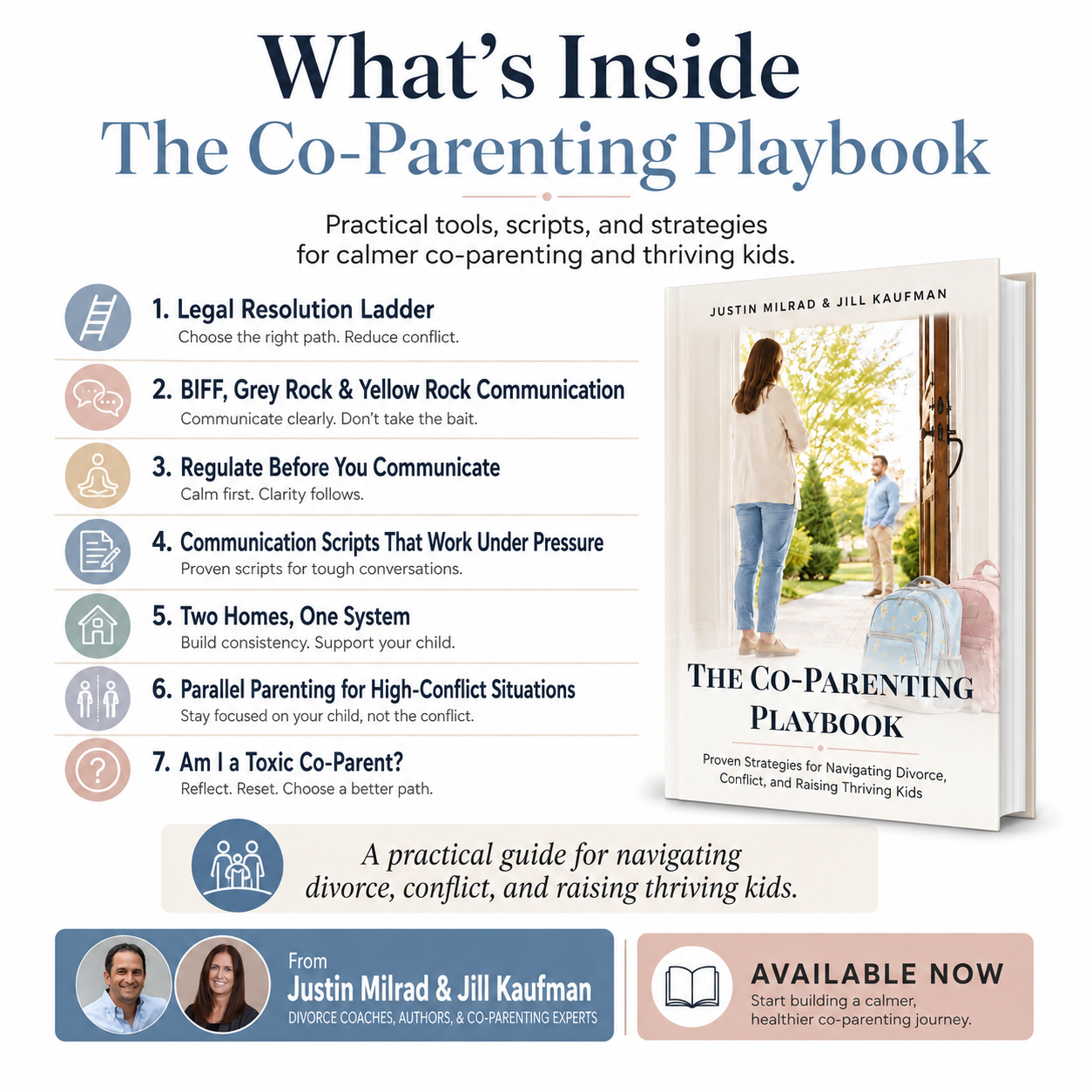

If you are struggling with co-parenting. This book is for you.
The Co-Parenting Playbook gives you practical tools, scripts, and strategies to communicate with less conflict, create more consistency between two homes, set healthier boundaries, and keep your child’s well-being at the center of every decision.
You do not need a perfect relationship with your ex to become the calm, steady parent your child needs. You just need a clear system, the right language, and a plan you can return to when emotions run high.
Ready to Dive Deeper Into Your Conscious Divorce Transformation?
Explore the complete frameworks and get hands-on tools to accelerate your transformation journey.
Book A Free Strategy Call
30 minute call. No pressure. Just clarity and a plan.
10-minute Divorce Readiness Quiz
Not ready to talk yet? Start here