
The Gap and the Gain: Why You Feel Stuck After Divorce
By: Justin Milrad – CDC Certified Divorce Coach®, Marriage and Relationship Coach, MBA, Financial Planner
You can make real progress after divorce and still feel completely stuck when you’re measuring yourself against where you think you should be. The Gap and the Gain framework offers a different way to see your recovery by comparing where you are now with how far you’ve already come.
What You’ll Learn
- Why you can make meaningful progress after divorce and still feel stuck when you measure yourself against where you think you “should” be.
- How the Gap and the Gain framework shifts your focus from an unreachable future standard to evidence of how far you’ve already come.
- How comparison, moving goalposts, and repeated “should” statements can make divorce recovery feel slower than it really is.
- Three practical ways to notice progress: a daily gain journal, a three-month rewind, and reframing your “shoulds.”
- How measuring progress differently can strengthen resilience, confidence, and your sense of agency as you rebuild your life.
Why Divorce Can Make You Feel Stuck Even When You’re Making Progress
One of the most frustrating parts of divorce is that progress doesn’t always feel like progress. You can be functioning better, making difficult decisions, rebuilding routines, taking care of your children, and getting through days that once felt impossible, yet still look at your life and think, I’m getting nowhere.
Justin saw this with a client he calls Rachel. She had been married for 15 years, had two children, and was trying to rebuild after her husband left the marriage for someone at work. About six months after her divorce was finalized, Justin asked her a seemingly simple question: What progress had she made?
Her first response was a list of everything that still wasn’t right. She was in the same house and struggling with the mortgage. She still disliked her job. Her children were having a hard time. She had gained weight and hadn’t started dating. Meanwhile, her ex appeared to be moving forward, complete with a new engagement and vacation photos on social media.
From Rachel’s point of view, six months had passed and almost nothing had changed.
Then Justin changed the question.
Instead of asking where she thought she should be now, he asked her to remember what life had actually looked like during the week after her husband left.
Back then, getting out of bed was difficult. She was missing work, crying constantly, struggling to eat, experiencing panic attacks, and trying to parent while feeling emotionally overwhelmed. Her children had seen their mother in a condition they had never witnessed before.
Now she was getting up every morning and going to work consistently. She was cooking dinner most nights. She and the kids had created a Friday movie-night tradition. She had joined a support group, started therapy, and was sleeping through most nights.
The mortgage was still difficult. Her ex was still engaged. She still had problems to solve. But the idea that she had made no progress simply wasn’t supported by the evidence.
She had gone from struggling to function to actively building a new life.
Sometimes feeling stuck after divorce isn’t evidence that you aren’t moving forward. It’s evidence that you’re using the wrong point of comparison.
That distinction is the foundation of a framework called The Gap and the Gain, developed by Strategic Coach co-founder Dan Sullivan and later explored with organizational psychologist Dr. Benjamin Hardy. Sullivan originally developed the idea while working with ambitious entrepreneurs who could achieve significant goals and still feel dissatisfied because they were continually comparing themselves with an ideal they hadn’t reached. The same pattern can show up powerfully during divorce.
What Are “The Gap” and “The Gain”?
The basic idea is simple: your experience of progress depends partly on what you use as your measuring stick.
The Gap: Measuring Yourself Against Where You Think You Should Be
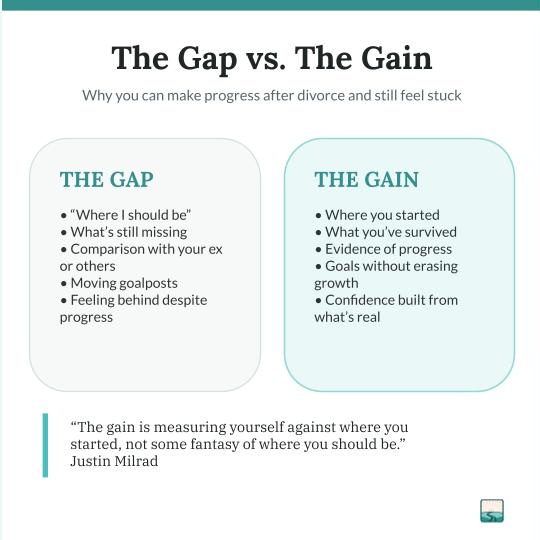
The Gap is the distance between where you are and an imagined version of where you believe you should already be.
During divorce, that imagined standard can sound like:
- I should be over this by now.
- I shouldn’t still be crying.
- I should have seen the warning signs.
- I should be dating already.
- I should be happier now that the divorce is over.
- I should have more money saved.
- My ex has moved on. Why haven’t I?
The problem is the word should quietly assumes there is a correct timeline for recovering from divorce. There isn’t one universal schedule that tells you when grief should disappear, when dating should feel comfortable, or when your finances, family routines, confidence, and identity should all feel settled again.
When you measure your life against an imagined timeline, progress can become almost invisible. Instead of noticing what you’ve handled, you focus on what hasn’t happened yet.
Comparison makes the Gap even wider. You may compare yourself with your ex, another divorced person, the families you see at your child’s activities, or even the married version of yourself from years ago. Social media can make that comparison particularly distorted because you’re often comparing the hardest parts of your private life with carefully selected pieces of someone else’s public life.
The Gain: Measuring Yourself Against Where You Started
The Gain changes the direction of the measurement.
Instead of asking, How far am I from the life I think I should have?, you ask, How far have I come from where I started?
“The gain is measuring yourself against where you started, not some fantasy of where you should be.”Justin Milrad
Rachel’s circumstances didn’t magically change when she looked backward. What changed was her ability to see evidence that had been there all along.
Six months earlier, she couldn’t imagine laughing again. Then one evening her daughter made a ridiculous joke at dinner and Rachel laughed hard for the first time in months. Six months earlier, grocery shopping could trigger panic. Now she could shop, run errands, work, cook, and handle everyday responsibilities without falling apart.
Most importantly, she had once wondered whether she could survive what was happening. Months later, she had an answer.
She already had.
| Living in the Gap | Living in the Gain |
|---|---|
| “Where should I be by now?” | “Where was I when this started?” |
| Focuses on what is still missing | Looks for evidence of progress |
| Measures against an imagined future | Measures against your actual past |
| Makes goalposts easy to move | Makes completed steps visible |
| Invites comparison with an ex or other people | Keeps the comparison anchored to your own journey |
Why the Gap Keeps Moving After Divorce
Justin compares the Gap to the horizon you see from an airplane. The horizon helps orient you, but you never actually arrive at it. You can fly toward it for hours and it remains out in front of you.
An ideal can work the same way.
You might tell yourself, Once I lose 20 pounds, I’ll feel confident enough to date. Then you lose the weight and the standard changes: I need better profile pictures first. After that it becomes, I’ll date seriously when I’m earning more money.
The destination keeps moving.
That is why a person can accomplish something objectively difficult and immediately discount it because the next milestone has already taken its place. Sullivan observed this pattern among entrepreneurs who reached major goals but focused almost instantly on what they hadn’t achieved. Justin recognized the same pattern in people going through divorce.
He recognized it in himself too.
During his own divorce, Justin carried an additional expectation: he was a relationship expert and divorce coach, so he believed he was supposed to have it all together. When the marriage ended, he measured himself against standards that were almost impossible to satisfy.
At his daughter’s volleyball games, seeing intact families could trigger the thought, That should be me. Looking at his bank account after attorney fees became, I should have more money. Watching his children struggle with moving between two homes became, I should have tried harder.
Notice what all of those thoughts have in common. None of them measures what Justin was actually doing or surviving in the present. Each measures reality against a different version of what life was supposed to look like.
That doesn’t mean goals are bad. Wanting a healthier relationship, more financial stability, better communication with an ex, or a fulfilling post-divorce life can give you direction. The problem begins when an ideal stops being a direction and becomes the standard you use to decide whether you are worthy, successful, healed, or doing divorce “correctly.”
Living in the Gain doesn’t mean abandoning goals or pretending divorce is easier than it is. It means allowing your past progress to count while you continue building what comes next.
Three Ways to Stop Feeling Stuck After Divorce
Understanding the Gap and the Gain is useful, but the real shift happens when you practice measuring progress differently. Justin recommends three simple exercises that turn an abstract idea into something you can use during ordinary, difficult days.
None of them requires you to pretend everything is fine. The point is to collect evidence that your current emotional state may not be telling the whole story about how far you’ve come.
1. Keep a Daily Gain Journal
At the end of each day, write down three gains.
Justin makes an important distinction here: this isn’t simply a gratitude list. You’re looking for specific evidence of progress.
Ask yourself:
- What did I handle today that would have overwhelmed me a month ago?
- What can I do now that I couldn’t do earlier in this divorce?
- Where did I respond differently than I would have a few weeks ago?
- What did I do today that shows I’m continuing to move forward?
The gains don’t have to be dramatic.
During his own divorce, Justin’s gains included dropping his children at school without crying in the parking lot when two months earlier he had cried almost every time. Another was having a difficult conversation with his ex about the holidays and staying calm when a similar conversation months earlier might have turned into a fight.
Even making dinner and sitting down together as a family counted because there had been a period when functioning well enough to do that felt difficult.
These aren’t headline-worthy victories. That’s exactly the point.
Divorce recovery often happens through small changes that are easy to dismiss because they don’t look like the final life you’re trying to build. Writing them down gives those changes somewhere to exist outside your mood on a particular day.
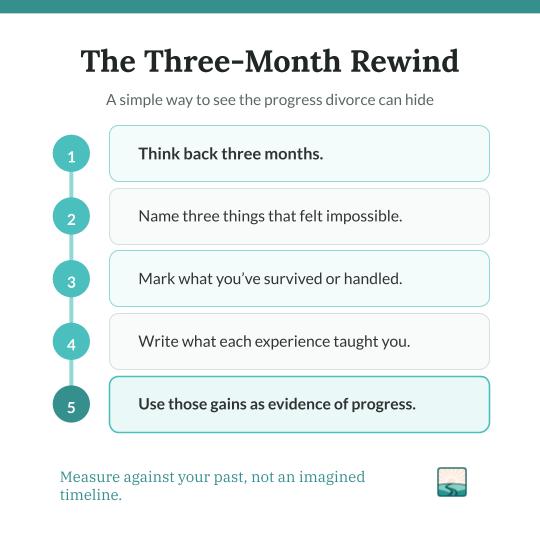
2. Do a Three-Month Rewind
The second exercise is to deliberately look backward.
Think about where you were approximately three months ago in your divorce journey. If that period doesn’t fit your situation, use another meaningful starting point: the week your spouse said they wanted a divorce, your first night alone, the day you told your children, the beginning of mediation, or another point that felt especially difficult.
Then get specific.
- Name three things that felt impossible at the time. Maybe it was sleeping alone, telling your children, attending your first therapy appointment, signing legal documents, or facing a holiday as a separated family.
- Ask whether you’ve now done or survived those things. Some may still hurt. The question is whether you have evidence that you can move through experiences you once feared would break you.
- Identify what has changed. What can you manage today that you couldn’t manage then? What feels less frightening? Where are you functioning differently?
- Write down what you actually learned about yourself. Not what you think you should have learned. What has the experience genuinely shown you?
You may discover that you can ask for help when you need it. You may be learning that painful emotions can be tolerated without controlling every decision. You may realize that your children have adapted to changes you were terrified to introduce, or that you’re capable of making decisions without automatically seeking your spouse’s approval.
The distance between those two versions of you is the Gain.
3. Reframe Your “Shoulds”
The third practice is deceptively simple: start noticing every time you tell yourself you should be somewhere else emotionally, financially, socially, or personally.
When you catch one, Justin suggests stopping and asking:
I should be over this by now.
Compared to what? A recovery timeline someone gave you? Your ex’s apparent progress? A version of divorce you imagined before you actually lived through one?
A Gain-based reframe might be: I’m further along than I was last month.
Or consider: I should be handling this better.
Better than when?
If you’re calmer during difficult conversations than you were at the beginning, asking for support instead of isolating, or recovering more quickly after hard days, then you may already be handling it better. You’re simply overlooking the evidence because you’re comparing yourself with an ideal instead of your actual starting point.
This takes repetition. If your mind has spent months measuring what is wrong, missing, late, or unresolved, you probably won’t replace that pattern after one journal entry. The practice is noticing the measurement and choosing a more useful one.
- Write down three things you handled today that represent real progress.
- Identify one “should” you’ve been using against yourself and ask, “Compared to what?”
- Look back three months and name one thing you can handle now that once felt impossible.
The Gain Is Not Toxic Positivity
Measuring the Gain does not mean pretending divorce is going well when it isn’t.
You can be dealing with serious financial pressure, ongoing litigation, a hostile ex, parenting conflict, grief, uncertainty, or children who are genuinely struggling. Looking for progress does not erase those realities.
Justin’s point is that there is a difference between acknowledging a difficult circumstance and adding another layer of suffering by insisting the circumstance should already be different.
In a high-conflict divorce, the Gap might sound like:
- We should be able to co-parent peacefully.
- I shouldn’t still be dealing with court.
- My ex shouldn’t be sending messages like this.
- I should have this under control by now.
Some of those wishes may be completely reasonable. But they may not describe the reality you’re living in today.
The Gain asks a different set of questions: Given that this is difficult, what am I learning to do?
What the Gain Can Look Like in a High-Conflict Divorce
Progress may mean you showed up to court even though you were terrified. It may mean you read a hostile email and waited before responding. Maybe you’re learning to set boundaries, document what matters, rely more on qualified professional guidance, or stop engaging in arguments that never lead anywhere.
The conflict may still exist. The financial problem may still exist. The legal issue may still need to be resolved.
But your capacity to deal with what is happening can change before the situation itself changes.
“The gain isn’t about denying reality. It’s about changing your relationship with reality.”Justin Milrad
That distinction matters because waiting for every external problem to disappear before you acknowledge your own growth leaves your sense of progress dependent on things you may not control.
The Gain brings some of that measurement back to you: How are you responding? What have you learned? What are you capable of today that you weren’t capable of before?
What If You’re Doing Everything Right and Still Feel Behind?
Justin saw another version of the Gap with a client he calls David.
David was about eight months past his divorce and, from the outside, doing many of the things people are encouraged to do while rebuilding. He was exercising, using dating apps, going on dates, and seeing a therapist.
Yet he kept showing up feeling defeated.
A date that went nowhere became proof that his dating life wasn’t working. A week of exercising became disappointing when the mirror didn’t change quickly enough. Every action was measured against the final result he wanted, so the progress inside the process barely registered.
Justin asked him to think back eight months.
Could he have imagined going on a date then?
David’s answer was essentially no. At that point, he believed he was fundamentally broken. He couldn’t imagine wanting to date, much less believing someone else would want him.
Now he was putting himself out there. He was meeting people, navigating rejection and disappointment, being vulnerable with strangers, and trying to understand what he actually wanted in another relationship.
He hadn’t found the partner he wanted yet, but that didn’t mean nothing was happening.
He was rebuilding confidence one experience at a time.
His mistake was measuring himself against finding the right person, an outcome still somewhere ahead of him, rather than comparing himself with the man who had once believed he would never date again.
Going on dates without finding a partner yet, working on your finances before they feel secure, or learning better boundaries while conflict still exists can all represent meaningful gains. The outcome doesn’t have to be complete for the progress to be real.
You 2.0: Divorce; A Better Way Forward
I thought my divorce would destroy me. Instead, it became the catalyst for creating a life more authentic and purposeful than I’d ever imagined possible.
You 2.0 is the blueprint I wish I’d had. Born from my own messy journey and refined through coaching others from survival to transformation. This isn’t about picking up the pieces of your old life. It’s about becoming the architect of something entirely new
Your Kids Are Watching How You Measure Progress
If you have children, the way you talk about your own progress after divorce can shape more than your internal experience. Your children are also watching how you respond when life doesn’t look the way you expected it to.
Justin’s concern is not that parents should hide grief, frustration, or difficult days. Children don’t need a parent who pretends divorce is painless. What matters is the larger message they see repeated over time.
Living primarily in the Gap can turn that message into: I’m failing because things aren’t perfect yet.
You might think:
- I should be a better parent right now.
- The kids shouldn’t still be struggling.
- Our family should feel normal again.
- I should be handling all of this without getting overwhelmed.
The Gain doesn’t ask you to lower your standards for parenting. It asks you to notice the progress that perfection-based thinking tends to erase.
Maybe last month you were barely getting through the evening routine and this month you’re sitting down for family dinners again. Maybe conversations with your ex still aren’t easy, but you’re getting better at pausing before responding. Maybe your children are still adjusting, but you’re becoming more consistent, more available, and more confident about setting limits.
Those changes count.
In higher-conflict situations, progress may also mean establishing clearer communication rules and refusing to pull the children into adult conflict. Reclaim & Reboot’s guide to setting and holding healthy boundaries during divorce offers practical examples for keeping communication calmer and more structured.
“Growth is about progress, not perfection. Falling down isn’t failure. Getting back up matters.”Justin Milrad
That is a useful lesson for children to witness because it gives them a model for their own difficult experiences. Hard days can exist alongside progress. A setback does not erase everything that came before it. You don’t have to handle a major life change perfectly in order to keep moving through it.
Justin describes this as creating an environment of growth rather than shame. Instead of making the family’s progress depend on everyone feeling happy or fully adjusted, you keep recognizing the smaller signs that all of you are learning how to live inside a new reality.
When you acknowledge your own gains, you can model a healthier definition of growth: keep showing up, learn from what happened, and recognize that getting stronger usually happens in small steps.
The Deeper Shift: Stop Putting Your Self-Worth in the Future
The Gap and the Gain eventually becomes about more than tracking progress. It changes where you look for evidence that you’re doing okay.
In the Gap, self-worth tends to become conditional:
- I’ll feel better when the divorce is finally over.
- I’ll feel confident when I lose the weight.
- I’ll know I’m okay when I find another relationship.
- I’ll feel successful when my finances recover.
- I’ll believe I’m a good parent when my kids stop struggling.
There is nothing wrong with wanting any of those things. The problem is making your ability to value yourself dependent on reaching them.
As Justin points out, the horizon keeps moving. Once one condition is met, another can easily take its place. If your internal standard is always located somewhere in the future, today can continually feel inadequate.
The Gain brings the measurement back to evidence that already exists. You survived the conversation you were terrified to have. You made a financial decision you once felt incapable of making. You got through the first holiday, the first night alone, the first court appearance, or the first week your children were at the other parent’s home.
Some of those experiences may still hurt. The Gain doesn’t require you to call them good. It asks you not to overlook what moving through them has revealed about your capacity.
Am I using my future goals to give me direction, or am I using them as evidence that the person I am today isn’t good enough?
That distinction also fits the original Gap and the Gain framework developed by Dan Sullivan: an ideal can provide direction, but measuring your current success against an ever-moving ideal can make actual accomplishments difficult to recognize.
For Justin, this connects directly with the work of rebuilding identity after divorce. In You 2.0, he describes becoming the architect of who you’re becoming. That becomes much harder when most of your attention is fixed on who you believe you should already be.
The Gain shifts the question from Why am I not there yet? to What am I building from here?
A 30-Day Gap and Gain Practice for Divorce Recovery
Justin’s recommendation is to practice this consistently rather than waiting until you feel discouraged.
For the next 30 days, use three simple habits.
| When | Practice | What You’re Looking For |
|---|---|---|
| Every night | Write down three gains from the day. | Specific evidence that you handled, learned, changed, or moved forward. |
| Whenever you hear “should” | Stop and ask, “Compared to what?” | An imaginary standard, comparison, or timeline that may be hiding actual progress. |
| Once a week | Do a three-month rewind. | What once felt impossible, what you have now handled, and what you learned from it. |
The exercise works best when your gains are concrete.
“I’m doing better” is vague. “I read my ex’s message and waited an hour before responding” is evidence.
“I’m stronger” is vague. “I got through my first weekend alone and made plans instead of staying in bed” is evidence.
“I’m becoming a better parent” is vague. “I was exhausted and still sat down to read with my child tonight” is evidence.
The goal isn’t to manufacture a positive interpretation of everything that happens. It is to become more accurate about what is changing.
“Every day you wake up and face this, you’re making gains.”Justin Milrad
When You Feel Stuck, Change the Way You Measure
About a year after Rachel’s divorce, Justin asked her the same question that had once caused her to sink into her chair: Tell me about your progress.
This time, she could see it.
She had met someone kind. Her children had told her they were proud of how she had handled the divorce. She had earned a promotion after finding the confidence to ask for what she believed she deserved. She had joined a gym and started taking painting classes on weekends.
But the biggest change wasn’t any individual accomplishment.
She told Justin that she actually liked who she was now.
During her marriage, she had spent years feeling as though she was supposed to fit into a version of herself that wasn’t entirely authentic. As she rebuilt, divorce became part of a larger process of discovering what mattered to her and who she wanted to become.
That is the deeper opportunity inside the Gain.
You can acknowledge what divorce has cost you without allowing loss to become the only measurement that counts. You can want your life to improve without using every unfinished part of it as proof that you’re failing.
Both realities can exist at once: this is hard, and you are making progress.
Tonight, start small. Write down three gains from today.
Maybe you got out of bed when you wanted to stay there. Maybe you didn’t send the angry text. Maybe you let yourself cry and then continued with the day. Maybe you read to your kids, made a meal, attended the meeting, called the therapist, reviewed the budget, or simply made it through a day you weren’t sure you could handle.
Those actions may not look like your final destination.
They are still movement.
Keep your goals. Keep building what comes next. Just don’t let the distance still ahead erase the distance you’ve already traveled.
For more conversations and practical tools for navigating and rebuilding after divorce, visit The Conscious Divorce Podcast or explore the Reclaim & Reboot resources and Divorce Readiness Quiz.
Frequently Asked Questions
Why do I still feel stuck after divorce?
Feeling stuck doesn’t necessarily mean you haven’t made progress. You may be measuring yourself against where you think you should be rather than comparing your current abilities, routines, and emotional capacity with where you actually started. Ongoing grief, legal problems, financial stress, parenting challenges, or other circumstances can also make progress difficult to recognize.
What is the Gap and the Gain concept?
The Gap and the Gain is a framework developed by Strategic Coach co-founder Dan Sullivan. The Gap means measuring yourself against an ideal or imagined future and focusing on the distance you haven’t covered. The Gain means measuring backward from where you are today to where you started so that actual progress becomes visible.
How do I know if I’m actually making progress after divorce?
Look for concrete changes rather than waiting to feel completely healed. You may be sleeping better, missing fewer days of work, communicating more calmly, asking for help, making financial decisions, creating new routines with your children, setting healthier boundaries, or recovering more quickly after difficult moments. Compare what you can handle today with what felt impossible earlier in the divorce.
Does focusing on the Gain mean ignoring grief or difficult emotions?
No. The Gain is not about denying grief, conflict, financial strain, or other painful realities. You can acknowledge that something is genuinely difficult while also recognizing the ways you are learning, adapting, and becoming more capable of handling it.
Reclaim → Reboot → Become YOU 2.0
Divorce is too important to figure out as you go.
Reclaim & Reboot helps people prepare for the legal, financial, parenting, and personal decisions that come with divorce so they can make better use of their professional team and move forward with greater clarity.
Book a strategy call with before your next attorney meeting or major divorce decision.
Book A Free Strategy Call
30 minute call. No pressure. Just clarity and a plan.
Reserve Your Intensive Session
Prepare yourself for all high-stakes divorce situations.